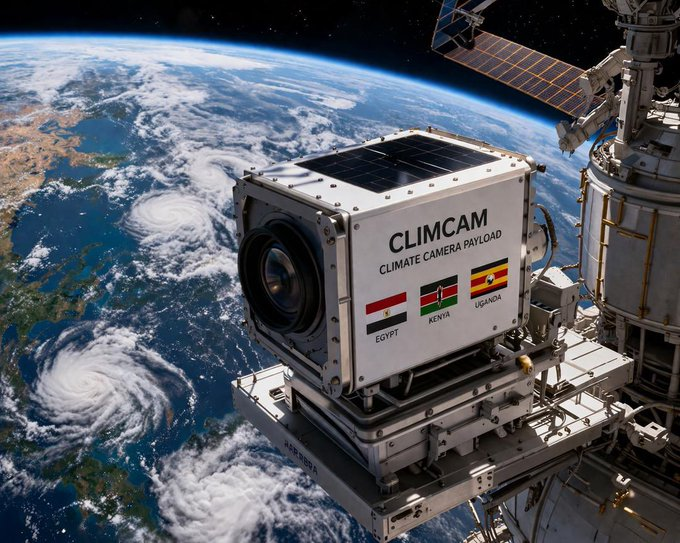
Ugandan engineers have developed an artificial intelligence-powered climate monitoring camera, ClimCam, set for launch to the International Space Station (ISS) on Friday, April 10, 2026, aboard a SpaceX Falcon 9 rocket in a landmark Earth observation mission.
The system forms part of a regional space collaboration between Uganda, Kenya, and Egypt under the UNOOSA–Airbus “Access to Space for All” programme, aimed at strengthening climate resilience and environmental monitoring across Eastern Africa.
Once deployed, ClimCam will operate from the ISS using the Airbus Bartolomeo platform, delivering high-resolution Earth imagery to support flood tracking, drought assessment, agricultural planning, and disaster response systems.
AI-powered climate intelligence system
The ClimCam payload is designed to generate approximately 10-metre resolution imagery and provide up to four orbital passes per day over Eastern Africa. The system integrates artificial intelligence tools to enhance near-real-time climate analysis, complementing existing ground-based weather stations and machine-learning early warning systems.

Officials say the technology will improve how governments in the region respond to climate shocks by enabling faster and more accurate environmental decision-making.
The project was developed through collaboration between the Uganda National Space Programme, the Kenya Space Agency, and the Egyptian Space Agency, following selection under the United Nations Office for Outer Space Affairs initiative.
The payload was built after a successful proposal under the UNOOSA–Airbus programme to host scientific instruments on the International Space Station’s external Bartolomeo platform.
Four Ugandan engineers behind the system
The government of Uganda funded the specialised training of four engineers who contributed directly to the design, development, and testing of the ClimCam system at the Egyptian Space Agency in Cairo.
The Ugandan engineering team includes: Gerald Kisangala, engineer and assistant engineer at Soroti University, Zaina Kalyankolo, engineer from Mbarara University of Science and Technology, Rosemary Nalwanga, engineer specialising in embedded systems and Christopher Ongom Adoko, mechanical engineer at Kyambogo University.
The engineers were selected through a public call, interviewed, and competitively chosen for their technical expertise in space systems engineering, embedded systems, and mechanical design.

Tested in Egypt and the United States
According to project information, the ClimCam payload underwent Assembly, Integration, and Testing at the Egyptian Space Agency facilities in Cairo, followed by end-to-end validation at Airbus facilities in Houston, Texas.
This process ensured full qualification for space operations ahead of its scheduled launch aboard a SpaceX Falcon 9 rocket as part of a Cygnus NG-42 mission.
Strategic climate and data benefits
Once operational, ClimCam is expected to provide critical environmental intelligence for Eastern Africa, including real-time data for disaster preparedness, natural resource management, and climate adaptation planning.
The mission also represents a step forward in Africa’s efforts to build data sovereignty, allowing participating countries to independently access and analyse high-value Earth observation data.
Officials say the project strengthens Uganda’s position in the global space science ecosystem while building domestic technical capacity in satellite systems and artificial intelligence applications.
Building national capability
Speaking on the broader significance of the programme, the Minister for Science, Technology and Innovation, Dr Monica Musenero, emphasised that the engineers’ participation reflects Uganda’s long-term investment in science and innovation capacity building.

“They were selected through an open and competitive process, and we are proud of the expertise they now represent for the country,” she noted.
Regional cooperation in space science
The ClimCam mission highlights growing collaboration between African space agencies and international partners, positioning the region as an active contributor to global Earth observation systems.
By combining AI, space-based imaging, and regional cooperation, the project is expected to enhance how Eastern Africa monitors and responds to climate change.