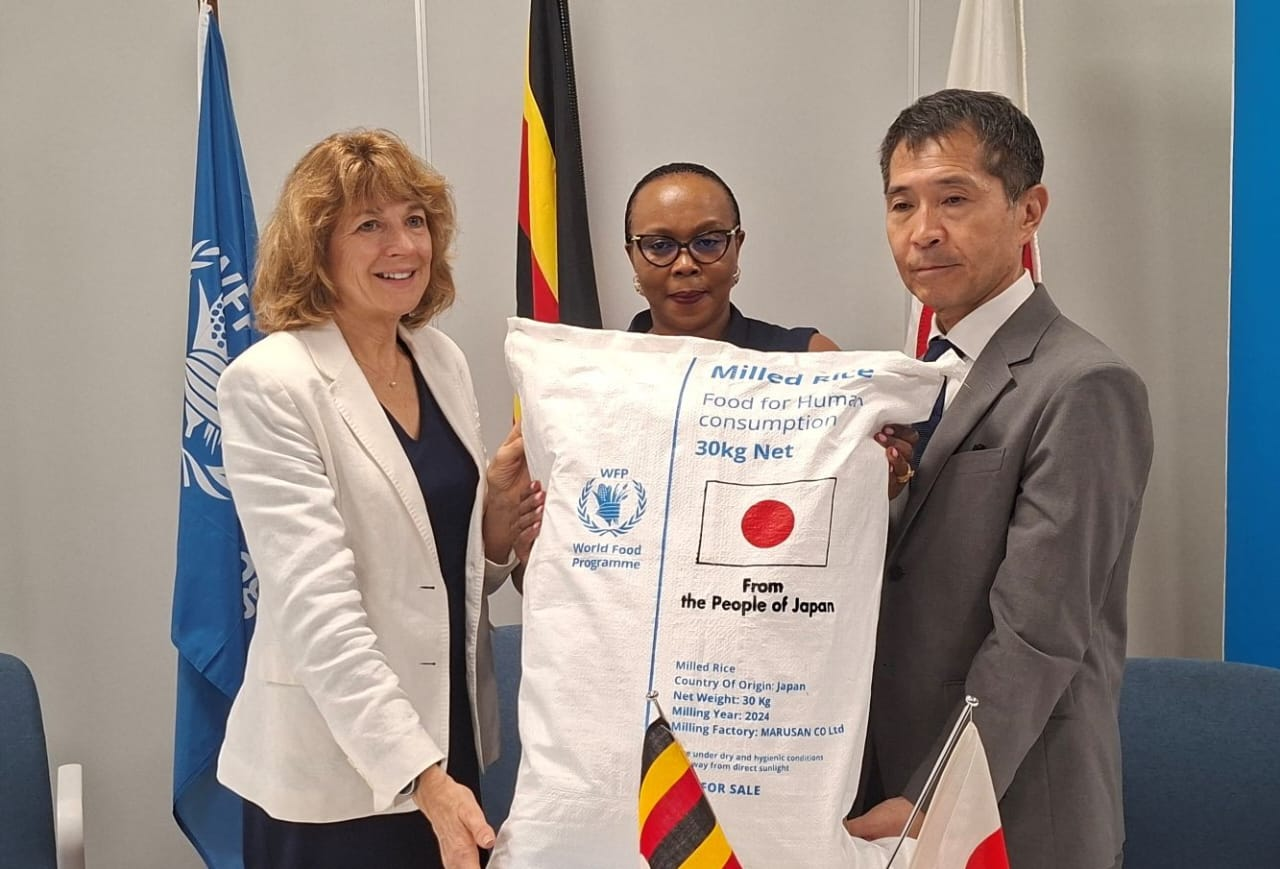
The United Nations World Food Programme (WFP) in Uganda has welcomed a generous contribution of 1,159 metric tons of rice, valued at USD 2.2 million, from the Government of Japan.
The donation will support WFP’s efforts to provide hot, nutritious meals to newly arriving refugees at reception and transit centres across Uganda in 2026.
“Japan remains committed to working hand in hand with Uganda and its partners to address humanitarian challenges,” said Norimasa Yoshida, Deputy Ambassador of Japan to Uganda.
He added, “Our contribution will enable WFP to serve hot, nutritious meals to refugees during their first days in Uganda—those critical moments when families arrive at reception and transit centres after long and exhausting journeys, often with very few belongings and facing immediate uncertainty about their future.”
Uganda currently hosts 1.9 million refugees, the largest refugee population on the African continent. In 2025 alone, the country welcomed nearly 145,000 newly displaced individuals fleeing conflicts in Sudan, South Sudan, and the Democratic Republic of Congo.
Despite Uganda’s progressive refugee policy, many refugees have limited livelihood opportunities and remain reliant on humanitarian assistance.
Lauren Landis, WFP Uganda’s Country Director, praised Japan for its timely support.
“Japan’s rice contribution will be used in reception and transit centres where refugees arrive immediately after crossing the border,” Landis said. “Before they are allocated land by the government, WFP provides hot meals in temporary shelters. This rice will offer much-needed energy and warmth, ensuring that the most vulnerable receive dignified support at their moment of greatest need.”
Representing the Permanent Secretary, Alex Kakooza, the Undersecretary for Refugees and Disaster at the Office of the Prime Minister, Ms Jane Nantale, highlighted the significance of international partnerships in sustaining Uganda’s refugee response.
“Sustaining this humanitarian response under our progressive Open Door refugee policy requires strong international partnership and shared responsibility—a principle that Japan has consistently embodied,” she said. “By ensuring food availability at entry points, Japan is directly supporting the stability and security of our refugee response. This contribution reassures us that in our effort to provide sanctuary to the displaced, Uganda does not walk alone.”
The support comes at a critical time. In May 2025, WFP was forced to suspend assistance to one million refugees due to severe funding shortfalls and to drastically reduce rations for 700,000 others. WFP data indicate that while targeted food assistance has reduced food insecurity among the most vulnerable, severe food insecurity has increased among households not receiving aid.
The Japanese rice contribution will help bridge this gap, providing immediate sustenance for refugees as WFP continues to mobilise resources to address ongoing food security challenges in Uganda.