KIGALI — Paul Kagame, President of Rwanda, has defended his country’s security posture in relation to the ongoing conflict in eastern Democratic Republic of the Congo (DRC), saying Rwanda cannot ignore threats along its borders.
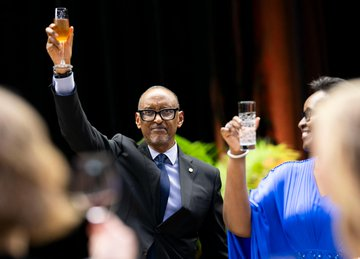
Speaking during a diplomatic dinner in Kigali for members of the diplomatic corps — including newly accredited envoys — Kagame said the decades-long instability in eastern Congo continues to pose security risks for Rwanda.
“The conflict in eastern DRC is neither new, nor is it too difficult to understand,” Kagame told diplomats. “It has been prolonged for decades due to neglect and complacency, notably by those with the power to make the biggest difference in resolving it.”
The eastern DRC has been plagued by armed groups for years, with dozens of militias operating in the region. Among the groups Rwanda frequently cites as a threat is the Democratic Forces for the Liberation of Rwanda (FDLR), an armed group linked to perpetrators of the 1994 Rwandan Genocide.
Kagame argued that the continued presence of the group and allied militias near Rwanda’s border leaves his government with limited options.
“As things stand, Rwanda faces an impossible choice: to either tolerate the continued presence of the FDLR and its growing network of militias and allow them to grow closer to our border, or to defend ourselves and be condemned for it,” Kagame said.
“The choice is therefore very clear. In our position, would any other country make a different choice?”
Relations between Rwanda and the Democratic Republic of the Congo have been strained in recent years, with Kinshasa accusing Kigali of backing the March 23 Movement (M23) rebel group operating in North Kivu province. Rwanda has repeatedly denied the allegations, instead blaming the Congolese government for cooperating with the FDLR.
During his remarks, Kagame said Rwanda’s defensive posture is shaped by its history and geography.
“Rwanda, because of its history and its geography, requires defensive borders,” he said. “Our defensive measures are aimed at this objective, and nothing else.”
He added that every nation has a responsibility to protect its citizens and territorial integrity.
“One thing that has not changed is the right and duty of every nation to ensure the safety of its borders and its people. It is that duty that never changes. Rwanda is no exception,” Kagame said.
The president also stressed that Rwanda remains determined not to return to the instability that preceded the 1994 genocide.
“We have made a promise to ourselves to never go back to the dark days, to that darkness. We can’t go back and that is not something we will waver from,” he said.
Kagame further noted that geopolitical shifts and unresolved regional conflicts continue to shape security dynamics in the Great Lakes region.
“Nowadays, none of us can afford to be indifferent to geopolitical trends. Changes are underway which will affect all of us,” he said.
Eastern Democratic Republic of the Congo remains one of Africa’s most volatile regions, with the conflict involving Congolese forces, rebel groups such as M23, and various regional diplomatic efforts aimed at restoring stability.
Kagame said lasting peace will require all parties to fully implement peace agreements rather than shifting responsibility to one side.
“By definition, a signed peace agreement should bind all parties equally and implementation should follow the text. However, that has not been our experience,” he said. “What we see instead is that one party is expected to carry almost the whole burden.”
Regional leaders and international mediators have continued to push for dialogue to resolve the crisis, which has displaced millions of civilians in eastern Congo and heightened tensions between neighbouring states in the Great Lakes region.