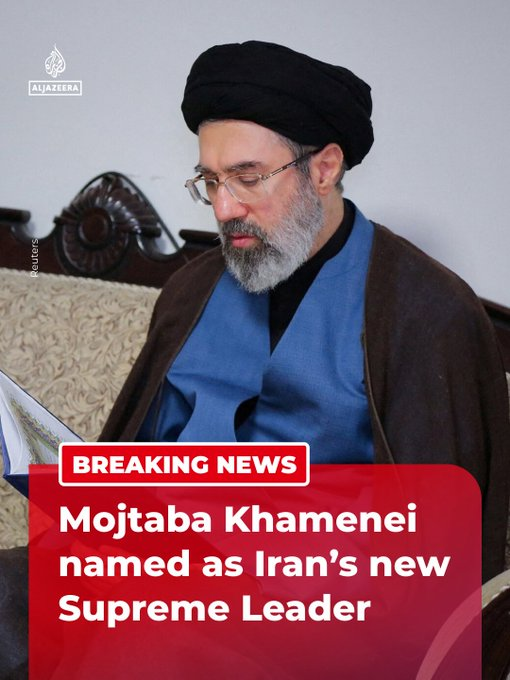
TEHRAN, Iran — Iran’s state media has announced that Mojtaba Khamenei, the second son of the late Ali Khamenei, has been appointed as the country’s new Supreme Leader following his father’s death.
The decision was made by Iran’s Assembly of Experts, the clerical body responsible for selecting the Supreme Leader, after an extraordinary session that confirmed Mojtaba Khamenei as the Islamic Republic’s third leader since the 1979 revolution.
Iranian state television reported that the assembly chose the 56-year-old cleric with strong backing from senior political and religious figures. Public celebrations were reported in parts of Tehran following the announcement.
Succession after death of Ali Khamenei
Mojtaba Khamenei replaces his father, Ali Khamenei, who had served as Iran’s Supreme Leader since 1989. His father’s death occurred amid an escalating regional conflict involving Iran, Israel and the United States.
Analysts say Mojtaba Khamenei had long been considered a potential successor due to his close connections to Iran’s political and security establishment, particularly the Islamic Revolutionary Guard Corps.
Despite maintaining a relatively low public profile, he has for years operated behind the scenes within his father’s office and cultivated influence among conservative political and military elites.
Historic and controversial transition
The appointment marks the first time in the history of the Islamic Republic that leadership has effectively passed from father to son, a development that has sparked debate about dynastic succession in a system originally created to reject monarchy.
Supporters in Iran have welcomed the move as a sign of continuity, while critics warn it may deepen political divisions and reinforce hardline control over the country’s institutions.
The leadership transition comes at a time of heightened tensions in the Middle East, with ongoing military exchanges and disruptions to global energy markets following the widening conflict involving Iran and its regional rivals.
Observers say Mojtaba Khamenei now faces the challenge of consolidating power while guiding Iran through one of the most volatile periods in its modern history.