Kampala — At least 12.4 million Ugandans are living in multidimensional poverty, according to newly released data from the Uganda Bureau of Statistics (UBOS), highlighting deep inequalities in access to basic services across the country.
The findings, drawn from the 2024 census and the Multidimensional Poverty Index (MPI), show that 27% of Uganda’s total population of 45.9 million people experience overlapping deprivations in health, education, and living standards.
Breaking Down the Numbers
The statistics translate into approximately 12,394,463 Ugandans living in poverty, based on the national population count.
This figure is striking when placed in context: It is more than half of Uganda’s male population, estimated at about 21.5 million. It represents over half of the country’s children and teenagers, given that nearly 50% of Ugandans are under 18.
It is equivalent to almost nine years of population growth, considering Uganda’s annual growth rate of about 2.9%, which adds roughly 1.3 million people each year.
Rural Areas Hit Hardest
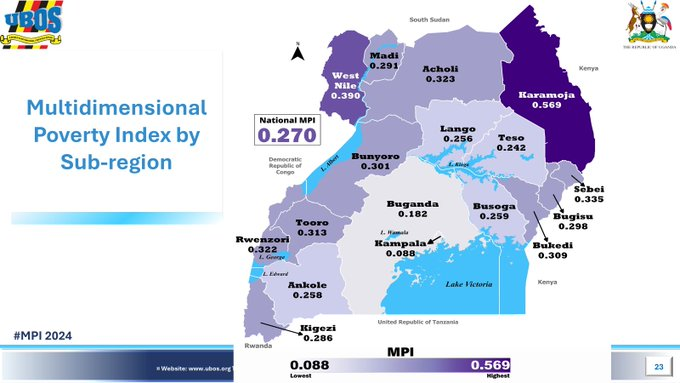
UBOS data shows that poverty is significantly more widespread in rural areas, where 31.5% of residents are affected, compared to just 7% in urban centres.
Regional disparities are also stark. The Karamoja sub-region remains the most affected, with poverty levels as high as 56.9%, followed by West Nile (39%) and Sebei (33.5%). By contrast, Kampala records the lowest levels at just 8.8%.
Beyond Income Poverty
According to UBOS Executive Director Chris N. Mukiza, the report underscores that poverty is not only about income, but also about deprivation of basic human needs and freedoms.
He noted that multidimensional poverty includes challenges such as: lack of access to clean and safe water, poor sanitation and inadequate toilets, use of unsafe cooking fuels and limited access to healthcare, with more than half of the poor lacking health insurance.
“Poverty is not just about money—it is about losing a child due to unsafe water, lacking representation, and being denied basic freedoms,” Mukiza emphasised.
Call for Action
Development partners, including the World Bank and United Nations Development Programme, have welcomed the report, describing it as a critical tool for designing targeted interventions and policies.
Experts say the data should guide government planning, resource allocation, and social protection programs, especially in the most affected regions.
As Uganda continues to experience rapid population growth, the report raises urgent questions about whether economic gains are translating into improved living conditions for millions of citizens.
The findings are expected to inform ongoing policy discussions as the government aligns national development strategies with global sustainable development goals.