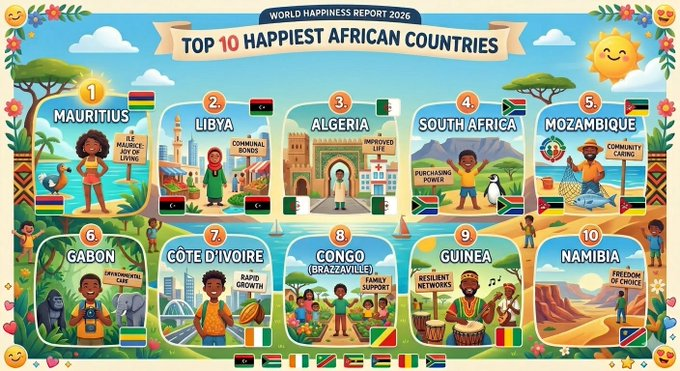
GLOBAL / AFRICA — The World Happiness Report 2026 highlights Africa’s complex well-being landscape as global youth happiness declines, particularly in Western nations.
While North America and Western Europe see falling happiness among those under 25, African nations show more varied trends, with many countries maintaining or improving youth life satisfaction.
Journalist Charles Onyango-Obbo notes: “The World Happiness Report 2026 confirms a fascinating shift in global well-being, where the long-standing ‘Nordic Model’ continues to thrive while traditional Western powers face a measurable decline.”
African countries in context
The report identifies the 10 African nations facing the steepest challenges, often tied to prolonged conflict, economic instability, health crises, isolation, or low social support scores. These include countries where youth are most vulnerable to social and economic pressures, and mental health resources are limited.
Despite these challenges, the report emphasises that African youth overall have not experienced the dramatic declines seen in Western countries. In many nations, life satisfaction among adolescents remains stable, suggesting resilience despite high social media use. Data from the Middle East and North Africa, for instance, show that heavy social media use (more than five hours per day) is associated with higher stress and depressive symptoms, yet youth well-being has not fallen relative to adults.

Researchers highlight: “Outside the English-speaking world and Western Europe, the links between social media use and wellbeing are more positive, and they vary between platforms.” In Latin America, for example, platforms that facilitate communication are linked to higher life satisfaction, while those dominated by influencers and algorithmic feeds show negative associations.
Youth and the digital age in Africa
Social media use in Africa is high among certain groups, particularly Gen Z, men, single individuals, and those with higher education or affluence. The report cautions that heavy users are at risk of lower wellbeing, especially when platforms encourage passive browsing or social comparison.
The report also underscores the importance of social support and school belonging. “When school belonging goes from low (10th percentile) to high (90th percentile), the life satisfaction gains for girls…are four to six times greater than the impact of social media use,” highlighting protective factors that can offset digital harms.

Looking forward
While Western nations struggle with declining youth happiness linked to social media, African countries face unique challenges but have not seen equivalent drops. The report suggests policies that strengthen social support networks, education, and safe digital environments could enhance youth well-being across the continent.
“The central focus of this year’s report is the sharp decline in happiness among those under the age of 25 in Western nations. Researchers explicitly link this trend to the ‘digital age’, citing the corrosive effects of heavy social media use on self-esteem and the erosion of real-world social networks,” Onyango-Obbo observes, signaling lessons relevant for African policymakers seeking to safeguard adolescent wellbeing.
African nations, while confronting economic and social pressures, may offer insights for global strategies to maintain youth happiness in the digital era.