A senior road safety official at the Ministry of Works and Transport has warned that Uganda’s mandatory motor vehicle inspection system is headed for failure, citing structural, technical and governance weaknesses that he says undermine road safety objectives.
Mr Ronald Amanyire, a Principal Road Safety Officer at the Ministry of Works and Transport (MoWT), made the remarks in a series of public statements in which he strongly criticised the design and implementation of the motor vehicle inspection programme.
“Motor vehicle owners should prepare themselves for the substandard service that is now inevitable,” Amanyire said, arguing that the system lacks the foundational components required to function effectively.
Amanyire dismissed reports that he was dropped from the motor vehicle inspection programme, saying he was instead reassigned to head another section within the ministry.
“The insinuation that I was dropped is a desperate move. I was promoted to head another section. Creating positions out of thin air like ‘Head of Motor Vehicle Inspection’ is laughable,” he said.
Claims of systemic flaws
According to Amanyire, the inspection system will fail primarily due to the absence of a fully integrated management software system, which he said is critical for ensuring integrity and efficiency.
“Compensating SGS with UGX 109 billion without securing the management software undermines the entire inspection process. The software integrates machine results, generates failure reports, and issues certificates of roadworthiness without human interaction,” he said.

He further claimed that FACE Technologies was paid UGX 17.5 billion despite contractual provisions requiring the firm to recover its initial investment and hand over the software to the government at no cost.
Amanyire also raised concerns about outdated inspection equipment, noting that the SGS contract was limited to five years because the machinery would require replacement thereafter.
“It is now seven years, and the equipment has exceeded its useful life,” he said, adding that Actia Muller equipment was installed instead of MAHA systems, which were originally specified.
Inspection intervals and staffing questioned
Amanyire criticised the requirement for private vehicles to be inspected every two years, describing it as ineffective in promoting regular vehicle maintenance.
“Mandating inspection every two years is futile. It does not cultivate a culture of regular motor vehicle maintenance,” he said, arguing that the provision was a populist measure introduced in 2020.
He also warned that the proposed recruitment of inspectors through Integrated Transport Solutions could result in poorly trained personnel. “This will result in inspectors largely selected through nepotism,” Amanyire claimed, alleging political interference in recruitment processes.
Maintenance concerns
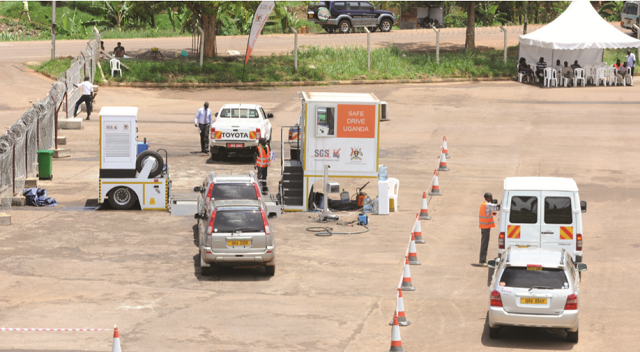
Amanyire further questioned the ministry’s capacity to maintain inspection infrastructure and equipment. “If we cannot maintain roads, how can we expect to maintain inspection facilities?” he asked, noting that several inspection stations remain branded SGS despite being government-owned.
Background to the dispute
Amanyire has previously been linked to investigations by the Inspectorate of Government (IG) over an alleged trip to South Africa in 2016, reportedly facilitated by SGS Global, at a time when the vehicle inspection contract was under consideration.
The IG had directed that Amanyire be submitted to the Public Service Commission for disciplinary action over alleged breach of standing orders. However, the ministry did not implement the recommendation.
Amanyire maintains that he was never found culpable and says he appeared before parliamentary committees without legal representation “because I had nothing to conceal.”
Ministry position
Meanwhile, the Ministry of Works and Transport says the mandatory motor vehicle inspection programme is aimed at improving road safety and is being rolled out in phases.
The ministry has published revised inspection fees, including: Motorcycles and tricycles: Shs50,500, Salon and dual-purpose vehicles: Shs52,000, Passenger vehicles (8–20 seats): Shs8,000, Passenger vehicles (21 seats): Shs8,500, Passenger vehicles (over 40 seats): Shs4,000.
Goods vehicles: Below 3.5 tonnes: Shs8,000, 3.5–10 tonnes: Shs5,500 and above 10 tonnes: Shs6,000.