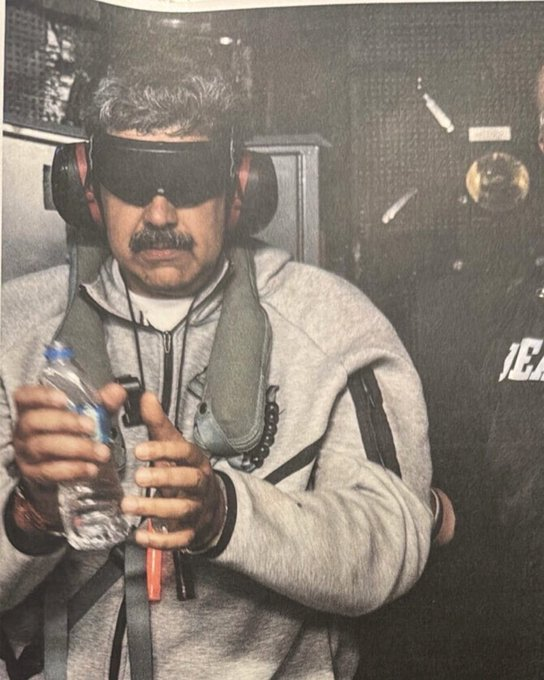
U.S. President Donald Trump on Saturday released photographs showing Venezuelan President Nicolás Maduro aboard the USS Iwo Jima, hours after U.S. forces captured the longtime leader in a dramatic military operation in Caracas that has triggered sharp international backlash and divided global opinion.
The images, circulated by the White House, show Maduro under U.S. military guard following what Washington described as a “targeted operation” that culminated in his arrest alongside his wife, Cilia Flores.
U.S. officials said the couple was flown to New York, where they are expected to face federal charges tied to narco-terrorism, drug trafficking and weapons offences stemming from a 2020 indictment that was recently unsealed and updated.
Announcing the operation, President Trump said the United States would temporarily “run” Venezuela during a transition period, arguing that Maduro’s removal was necessary to restore stability and accountability in the oil-rich nation after years of economic collapse and alleged human rights abuses.

The move immediately drew condemnation from several governments and international bodies, who described the strike and capture as a violation of Venezuelan sovereignty and international law.
Mayor Mamdani speaks
In New York, Mayor Zohran Kwame Mamdani said he had been briefed on the situation and raised concerns about the legality and local impact of the operation.
“Unilaterally attacking a sovereign nation is an act of war and a violation of federal and international law,” Mamdani said in a statement. “This blatant pursuit of regime change doesn’t just affect those abroad; it directly impacts New Yorkers, including tens of thousands of Venezuelans who call this city home. My focus is their safety and the safety of every New Yorker.”
African Union speaks
The African Union also issued a strongly worded communiqué expressing “grave concern” over what it described as the “abduction of the President of the Republic” and military attacks on Venezuelan institutions.

“The African Union reaffirms its steadfast commitment to the fundamental principles of international law, including respect for the sovereignty of States, their territorial integrity, and the right of peoples to self-determination,” the AU said, calling on all parties “to exercise restraint, responsibility, and respect for international law to prevent any escalation.”
Major powers speak
Major powers aligned with Caracas were swift to denounce Washington’s actions. China condemned the use of force and called for the immediate release of Maduro and his wife, while Russia, Cuba and Iran described the operation as illegal aggression. Moscow said it supported calls for an emergency meeting of the United Nations Security Council.
Several Latin American neighbours, including Brazil, Colombia and Mexico, expressed outrage over what they termed an intervention and violation of sovereignty.
European leaders struck a more cautious tone. EU foreign policy chief Kaja Kallas acknowledged that Maduro “lacks legitimacy” but stressed that “international law and the UN Charter must be respected,” urging restraint and a peaceful transition. European Commission President Ursula von der Leyen echoed the call to uphold international law.

By contrast, some leaders welcomed Maduro’s removal, if not the method. French President Emmanuel Macron said the Venezuelan people could “only rejoice” at the end of Maduro’s dictatorship, without directly endorsing the U.S. operation.
Argentina’s President Javier Milei celebrated the news on social media, writing, “FREEDOM MOVES FORWARD. LONG LIVE FREEDOM DAMMIT.” Ukraine voiced support, citing alleged human rights violations by Maduro’s government, while El Salvador’s President Nayib Bukele reposted earlier criticism of the Venezuelan leader, implicitly endorsing the outcome.
The United Nations said it was “deeply alarmed” by reports of strikes in Caracas and the capture of Venezuela’s president, warning that the actions may violate international law and calling for de-escalation.
As of Sunday, the situation in Venezuela remained fluid, with uncertainty over governance in Caracas and mounting diplomatic pressure on Washington ahead of potential debates at the UN.
For many governments, the episode has underscored deep geopolitical divides—between those who view Maduro as an illegitimate autocrat and those who argue that his removal by force sets a dangerous precedent in international relations.