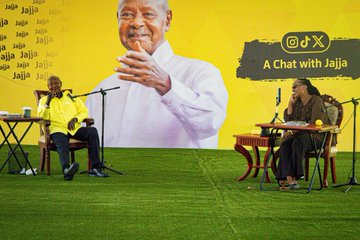
President Yoweri Kaguta Museveni on Sunday reaffirmed that prosperity is the central pillar of the National Resistance Movement (NRM) ideology, warning that Africa risks stagnation if young people fail to understand how wealth is created.
Speaking during the Jazz with Jajja dialogue with young Ugandans (Bazukulu) at State Lodge, Nakasero, the President responded to a question from journalist Simon Kaheru by stressing that sustainable prosperity is rooted in production and calculation.
“Prosperity does not come from begging,” President Museveni said. “It comes from producing a good or service and selling it sustainably, with calculation — ekibaro.”
The President explained that Uganda’s multi-tribal and diverse structure naturally created economic complementarities, which later shaped the NRM’s ideological pillars of Patriotism, loving Uganda as a market, and Pan-Africanism, embracing the wider African market.
“Uganda alone is not enough,” he noted, pointing out that the country now produces surplus milk, maize, bananas, cement and steel, all of which depend on regional and continental markets to remain viable.
Economy, Skills and Structural Transformation
Responding to questions from Christine Mawadri on Uganda’s youthful population, the creative sector and innovation, President Museveni traced the country’s economic challenges to the colonial-era enclave economy built around raw material exports.

By independence, he said, Uganda’s economy was dominated by the 3Cs—cotton, coffee and copper—and the 3Ts—tobacco, tea and tourism—covering only about four percent of homesteads.
“When the NRM came to power in 1986, even that small economy had collapsed,” he said, noting that the government had to rebuild almost from scratch.
The President highlighted progress made since then, including the revival and expansion of traditional exports, diversification into dairy, fisheries, fruits and manufacturing, value addition to raw materials, and the transition towards a knowledge economy, with local production of vehicles, vaccines and computers.
Despite these gains, he observed that by 2013, 68 percent of homesteads remained outside the money economy, prompting the introduction of Operation Wealth Creation and later the Parish Development Model (PDM).
“The key is guiding people into enterprises that make economic sense for their land size,” President Museveni emphasised, underscoring the importance of skills, planning and structural transformation in securing inclusive prosperity.