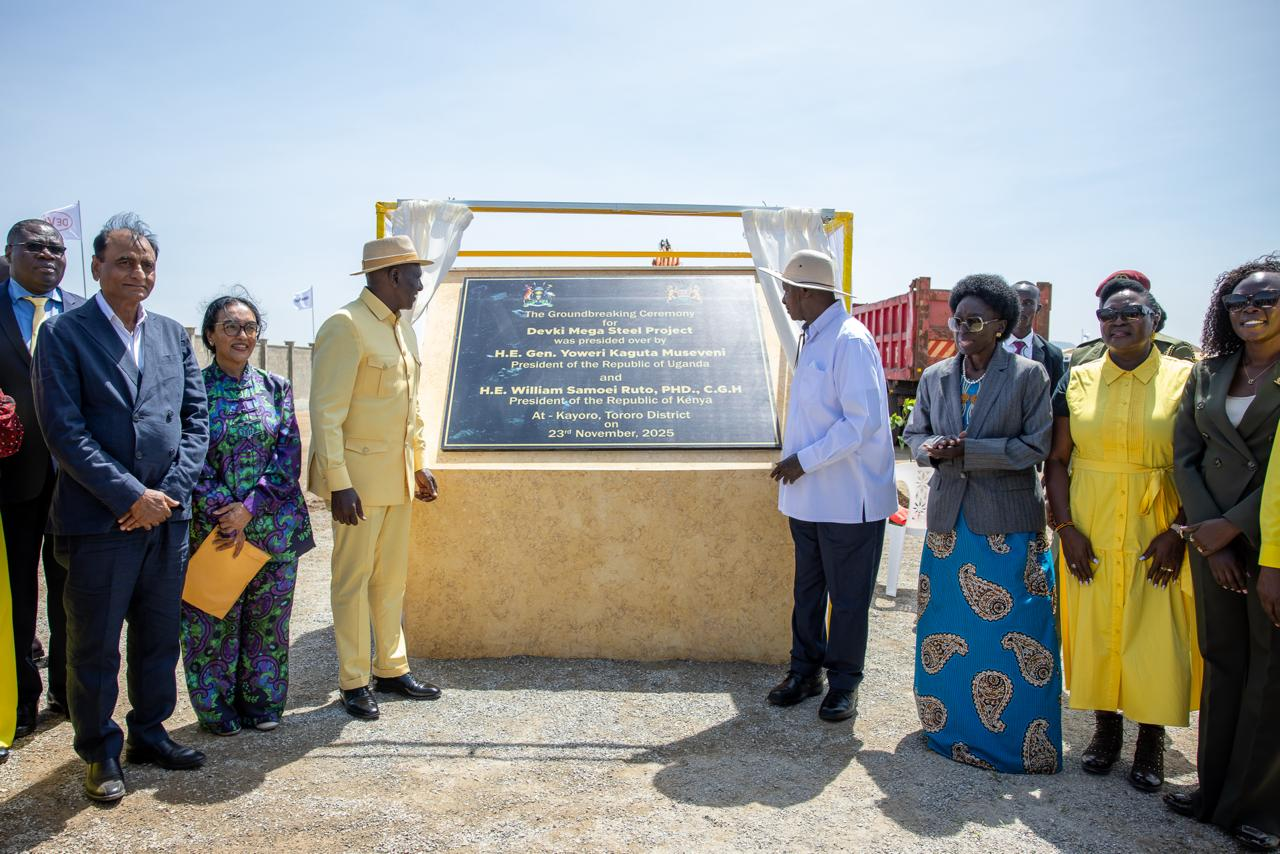
President Yoweri Kaguta Museveni and Kenya’s President William Samoei Ruto officiated at the groundbreaking of the USD 500 million Devki Mega Steel Plant in Kayoro Village, Osukuru County, Tororo District—an investment set to become one of East Africa’s largest industrial projects.
The facility, developed by Kenyan industrialist Dr Narendra Raval (Guru) of the Devki Group, is expected to employ more than 15,000 Ugandans across Tororo and Mbarara at commencement.
Dr Raval said the majority of the jobs will be generated through the plant’s vertically integrated steel operations and related value-chain activities, building on Devki’s existing investments in Tororo, Mbarara, and the soon-to-be-established Kabale iron ore refinery.

Placing the development within Africa’s broader historical context, President Museveni said the project signals a turning point in the continent’s struggle against centuries of economic injustice. For more than 500 years, he noted, Africa has lost value through slavery, colonialism, and modern extractive systems that export raw materials without processing them locally.
“Today, with the groundbreaking of the Devki Mega Steel project, we are in the process of liberating Africa,” President Museveni said. “This liberation means ending the export of our minerals and our jobs.”
He thanked President Ruto for encouraging Dr Raval to invest in Uganda, saying the gesture demonstrated Kenya’s recognition of Uganda’s strategic advantage as a natural source of raw materials. He urged Devki Group to fully manufacture steel sheets and other intermediate products locally to retain more value within Uganda.

President Museveni further revealed that Devki will establish another major iron ore project in Kabale, projected to create over 16,000 additional jobs. He cautioned communities against frustrating investors through compensation disputes, assuring that the government will handle all necessary payments. Uganda, he said, loses nearly USD 5 billion annually by importing products that can be locally produced.
The President also welcomed the planned extension of the Standard Gauge Railway (SGR) toward Tororo, calling Uganda’s heavy reliance on road cargo “irrational” for large-scale industrialisation. The SGR, he added, will help reduce transport costs for major industries like Devki.
President Ruto described the ceremony as a bold step in Africa’s march toward industrial self-sufficiency. “We convene here not just to commission a factory, but to usher in a new, audacious chapter in Africa’s industrialisation ambitions,” he said. Ruto praised President Museveni’s consistent leadership in advancing industrial development and regional integration within the East African Community (EAC).

He noted that the Tororo plant is expected to expand to 20,000 employees across East Africa by 2027, at a time when Africa’s steel demand is projected to rise from 39.5 million tonnes in 2024 to 52 million tonnes by 2034. Kenya will, in January, launch the next phase of the SGR from Mombasa to Naivasha and from Rironi to Malaba, with the line eventually extending to Tororo to support regional manufacturing.
Dr Raval thanked President Museveni for guiding the project and committing it to Tororo to create employment. He pledged that 90 percent of the factory’s workforce will come from the surrounding communities. “Importing steel is importing poverty,” he said. “We must produce here, create jobs here, and empower the youth.”
First Deputy Prime Minister and Minister for East African Community Affairs, Rt. Hon. Rebecca Kadaga said the project reflects deepening regional industrial integration. Energy Minister Hon. Ruth Nankabirwa called the groundbreaking a historic milestone in Uganda’s industrialisation journey and emphasised the need for the factory to deliver tangible socio-economic benefits for communities across the region.