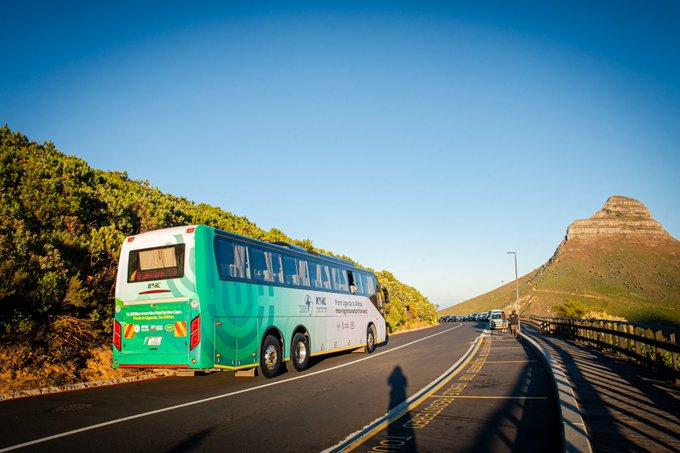
Uganda’s homegrown electric bus, the Kayoola E-Coach, has reached another iconic milestone after taking on South Africa’s famed Table Mountain, capping a historic overland journey from Kampala to Cape Town that has showcased African engineering, innovation and continental ambition.
Kiira Motors Corporation announced the moment on Thursday, describing the Table Mountain ascent as a symbolic highlight following the “Crown Event” in Cape Town. The achievement marks the successful completion of a 7,125-kilometre forward journey across multiple African countries, underscoring the viability of electric mobility across long-distance trade corridors on the continent.
“After the Crown Event, the Kayoola E-Coach took on Table Mountain – a symbolic moment marking the success of the 7,125km forward journey from Kampala to Cape Town,” Kiira Motors said. “African engineering. Continental ambition. Boundless possibilities.”
The expedition forms part of the African Electric Expedition (AEE), a pan-African odyssey designed to validate the performance of locally engineered electric vehicles under real-world African conditions, while promoting cross-border industrial collaboration and sustainable transport solutions.

According to Kiira Motors, the journey has already delivered tangible commercial and technical outcomes. During a stop in Johannesburg, the expedition secured sales contracts for 450 buses, while operational data confirmed an energy efficiency of 0.84 kWh per kilometre — a key benchmark for electric mobility in emerging markets.
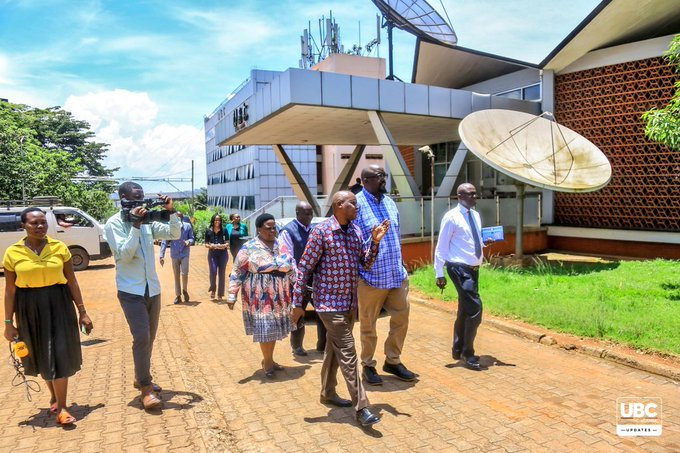
The Kayoola E-Coach and its 50-member expedition crew arrived in Cape Town on December 9, 2025, to a warm reception led by the Minister of Science, Technology and Innovation, Dr Monica Musenero Masanza.
High-level leaders, diplomats and strategic partners later convened in the city to celebrate what Kiira Motors described as a landmark commercial milestone and a defining step toward Africa’s industrial transformation.
“This journey celebrates African ingenuity, resilience and collaboration,” the company said, noting that the expedition validates Uganda’s engineering capabilities while helping define integrated digital and mobility requirements for Africa’s future trade corridors.
Data released by the Science, Technology and Innovation Secretariat shows that as of December 9, the expedition had covered 7,125 kilometres of its planned 13,922-kilometre route. Over the first 20 days, the electric fleet consumed 5,891.12 kilowatt-hours of energy, substituted approximately 2,707.5 litres of fuel, and avoided an estimated 3,240.12 kilograms of carbon dioxide emissions.

Dr Musenero, who has championed the expedition, said the initiative demonstrates the potential of African-built technologies to drive sustainable cross-border trade and reduce the continent’s carbon footprint. She emphasised that industrial cooperation and innovation are central to building a resilient continental economy.
The symbolic encounter with Table Mountain — one of the New Seven Wonders of Nature and an enduring emblem of Cape Town — added global resonance to the expedition’s message. Towering over the city at more than 1,000 metres above sea level, the flat-topped mountain served as a dramatic backdrop to the Kayoola E-Coach’s arrival, linking Africa’s natural heritage with its industrial future.
Launched with a “declaration of intent” in November, the African Electric Expedition was designed to provide “proof in motion” that Africa can design, build and deploy advanced electric mobility solutions at scale.
Kiira Motors says the journey has “redrawn the map of African industry,” positioning Uganda and its partners at the forefront of the continent’s transition to clean, locally manufactured transport.