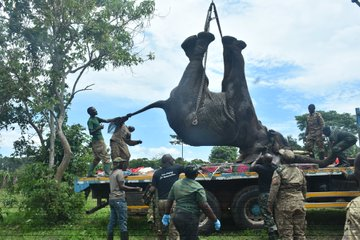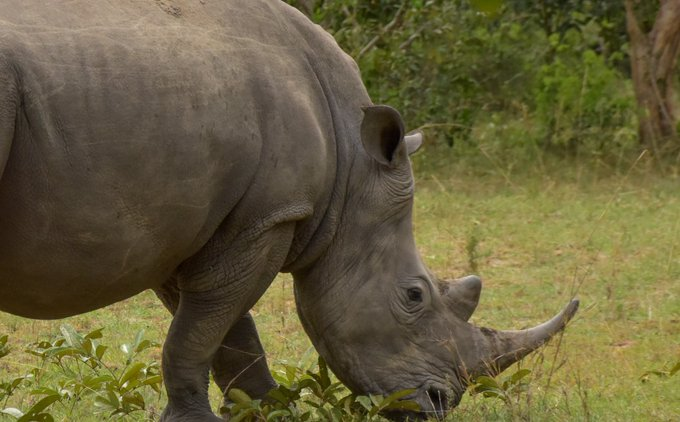
Uganda’s ongoing efforts to restore and protect its rhino population have gained fresh international attention with the announcement of the Roosevelt Rhino Campaign, an initiative that will see another Ugandan rhino named after a former United States president—Theodore Roosevelt.
The campaign was unveiled following the US–Africa Business Connect Roosevelt Africa Trail Conference held in New York City and is a collaborative effort between the Uganda Wildlife Authority (UWA), the Roosevelt Africa Trail, and the Theodore Roosevelt Association. Its official launch is scheduled for December 2025.
The Roosevelt Rhino Campaign draws inspiration from Theodore Roosevelt’s historic 1909–1910 Smithsonian–Roosevelt African Expedition, while firmly focusing on the present-day task of rebuilding Uganda’s rhino population after decades of extinction in the wild. Through this initiative, global audiences will follow the journey of the “Roosevelt Rhino” from protected sanctuary care to eventual rewilding.
The rhino will be formally christened in Uganda during a ceremony to be officiated by a member of the Roosevelt family, underscoring the campaign’s international significance. This will mark only the second time a Ugandan rhino has been named after a U.S. president, following the naming of “Obama,” the first rhino born at Ziwa Rhino Sanctuary, a name that resonated widely across East Africa.
Beyond naming the animal, the campaign is designed as a multi-platform engagement to support conservation. One of its flagship initiatives is Roosevelt Encounters Africa, a children’s educational series produced by NABU, featuring The Rhino Named Roosevelt. The series will incorporate QR codes that allow viewers to directly contribute to rhino conservation efforts.
Private sector partnerships and digital innovations are also central to the campaign. Roosevelt Africa Safari Coffee, developed by Kahawa 1893 in partnership with the Roosevelt Africa Trail, will feature the Roosevelt Rhino as a speciality blend, with a share of proceeds directed to conservation work.
Meanwhile, the Roosevelt Africa Virtual Trail will provide an immersive digital experience, allowing audiences worldwide to explore Uganda’s rhino habitats and conservation journey.
Speaking at the conference, Dr James Musinguzi, Executive Director of the Uganda Wildlife Authority, said Uganda’s progress in rhino conservation is the result of sustained investment, strong institutions, and reliable partnerships. He noted that initiatives like the Roosevelt Rhino Campaign play a key role in strengthening international understanding and support for wildlife recovery.

Joshua Sentongo, Director of Business Development and Strategy at the Roosevelt Africa Trail, described the campaign as a continuation of a family legacy in conservation. Sentongo is the son of the late conservationist Paul Ssali Naluma, whose story “The Wild and the Brave” was nominated for an Oscar in 1975.
The campaign also links conservation with culture and heritage. Dr Jackline Besigye Nyiracyiza, Acting Commissioner for Museums and Monuments, said the increased global visibility would raise the profile of sites such as Rhino Camp and Ajai Wildlife Reserve, positioning them as key destinations for heritage and conservation tourism.
She highlighted the role of Intelligent Trail Markers, developed with a tech consortium led by MIT Creative Technologist Rus Gant, in deepening visitor engagement with Uganda’s natural and cultural heritage.
The Roosevelt Rhino Campaign will roll out in phases, beginning with a hybrid launch in Uganda and the United States on December 18, 2025, including a live event at Ziwa Rhino Sanctuary. A mid-campaign engagement is planned at the Roosevelt Library on July 4, 2026, followed by the official christening of the Roosevelt Rhino in September 2026.
Through this initiative, Uganda is reaffirming its commitment to long-term wildlife recovery while inviting global partners, institutions, and individuals to support the careful and sustained work required to return rhinos to the country’s protected landscapes.