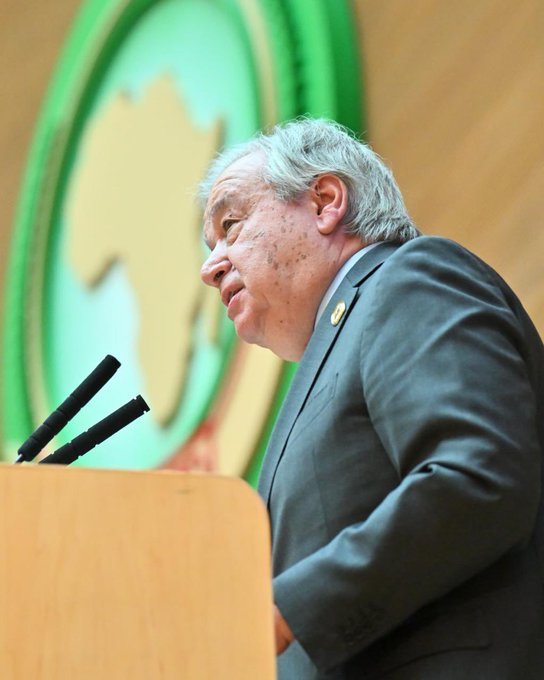
Addis Ababa, Ethiopia — At the 39th African Union Summit, United Nations Secretary-General António Guterres delivered a forceful call for climate justice and global institutional reform on February 14 at the African Union (AU) Summit in Addis Ababa, underscoring Africa’s outsized suffering from climate change despite its tiny share of global emissions.
Speaking to heads of state and government at the summit — themed around sustainable water and sanitation for Agenda 2063 — Guterres said Africa is paying “the highest price” for a crisis it did not cause, because it contributes only a small fraction of the world’s greenhouse gases.
“Africa did not cause the climate crisis, yet it faces faster-than-average warming, droughts, floods, hunger, and deadly heat — climate injustice, plain and simple,” he said, noting that developed nations are not delivering the support the continent needs.
Guterres urged wealthy countries to triple adaptation finance and work toward mobilizing $1.3 trillion annually for developing countries by 2035, arguing that current funding falls far short of what Africa needs to adapt to climate impacts and pursue a clean energy transition.
Despite Africa’s vast clean energy potential, including access to what the UN says is about 60 percent of the world’s best solar resources, the continent receives only about 2 percent of global clean energy investment, Guterres added, urging increased support for renewable infrastructure and resilience.
His comments echoed past findings showing that climate finance commitments often fail to meet the scale of the crisis. For example, an Oxfam analysis noted that wealthy nations provide only a tiny fraction of the funds needed for climate action in East Africa, even as the region endures severe droughts, hunger and lack of water access.
Africa’s Voice at the UN Security Council
Beyond climate, Guterres stressed the need for broader reform of global governance, highlighting the absence of permanent African seats on the UN Security Council as “indefensible.”
“This is 2026 — not 1946,” he said, calling on the international community to modernize institutions to better reflect current global realities and ensure that Africa is represented where key decisions are made.
His appeal comes amid wider African advocacy for greater representation on the council; the African Union’s long-standing Ezulwini Consensus calls for two permanent seats with full veto powers for African states, reflecting centuries-old calls to redress historical imbalance.
Continental Priorities and Youth Anger
The AU summit also spotlighted pressing development challenges facing the continent, from water and sanitation deficits to youth disenfranchisement. Reports from the summit noted that millions of Africans still lack basic access to safe water and sanitation services — essential components of climate adaptation and health resilience.
Meanwhile, young Africans have voiced frustration with what they describe as a gap between leaders’ talk and action on issues that affect their lives, from economic hardship to climate change and governance reform.
Global Climate Leadership and African Solutions
Guterres’s address aligns with recent efforts to position Africa as a leader in climate solutions, not merely a victim. The Africa Climate Summit (ACS-2) held in Addis Ababa last year showcased African-led climate innovation and ambition under the theme of financing resilient, green development.
As analysts and advocates have pointed out, delivering on climate finance commitments and reforming global institutions will be critical for Africa’s future — especially ahead of upcoming global negotiations such as COP30.