The Uganda National Examinations Board (Uganda National Examinations Board) has announced a record candidate turnout and improved pass rates in the 2025 Uganda Certificate of Education (UCE 2025) examinations, with 99.69% of candidates qualifying for the certificate.
The results were officially released at the State House, Nakasero, on Friday, February 13, 2026.
Record Candidate Registration and Attendance
A total of 432,163 candidates from 3,975 examination centres registered for the exams, up 20.2% from 359,417 in 2024. Of these, 429,949 candidates (99.5%) attended, while 2,214 candidates (0.5%) were absent, continuing a trend of declining absenteeism.
Of the total candidates, there were 204,292 (47.3%) males and 227,871 (52.7%) females, while 154,642 (35.8%) were Universal Secondary Education (USE) beneficiaries compared to 277,521 (64.2%) non-USE candidates.
A total of 708 Special Needs Education (SNE) candidates registered, slightly down from 743 in 2024. Of these, 342 were male, and 366 were female, with a categorical breakdown consisting of 27 blind, 116 low vision, 60 deaf, 90 dyslexic, and 72 physically handicapped candidates, alongside 343 others with various disabilities, including sickle cell anaemia, epilepsy, and accident-related conditions.

Attendance was nearly perfect, with only 4 absentees (0.6%). UNEB provided extensive support, including Braille papers, enlarged-print question papers, sign language interpreters, additional time, and specialised personnel.
Improved Performance Under Competency-Based Curriculum
The UCE 2025 examinations were conducted under the Competence-Based Curriculum (CBC). Candidate performance combines 20% Continuous Assessment and 80% end-of-cycle examination scores, graded from A to E.
The 2025 results show significant improvements over 2024, with 428,628 candidates (99.69%) qualifying for the UCE certificate under Result 1, while only 1,191 (0.28%) fell into Result 2 for not meeting all award conditions, and a mere 130 (0.03%) were categorised under Result 3 for scoring below the basic level in all subjects.
By comparison, 2024 saw 98.1% of candidates qualify, with 1.9% failing.
CBC Learners Show Stronger Skills
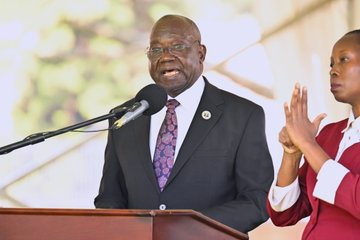
Prof. Celestino Obua, UNEB Chairperson, praised the CBC for producing learners with stronger competencies. “Whereas in 2024 UNEB was treading on new ground, the 2025 terrain proved far more familiar, with significantly improved institutional capacity,” he said.

A UNEB study comparing CBC learners to those under the former content-based curriculum found that CBC learners: demonstrate strong research skills, construct knowledge independently, exhibit greater creativity and innovation, communicate more effectively and show improved critical thinking and problem-solving abilities.
“These outcomes affirm that the CBC is not only relevant but strategic in shaping a competent, skilled, and globally competitive generation,” Prof. Obua said.
Driving Uganda Toward Middle-Income Status
The Board noted that the CBC equips learners with the competencies needed to drive Uganda’s socio-economic transformation and advance the country toward its middle-income status vision. A detailed summary report with further findings will be released by UNEB’s Executive Director.
The UCE 2025 results mark the second cohort of candidates under the CBC, consolidating UNEB’s commitment to improving education quality, candidate participation, and learner outcomes.