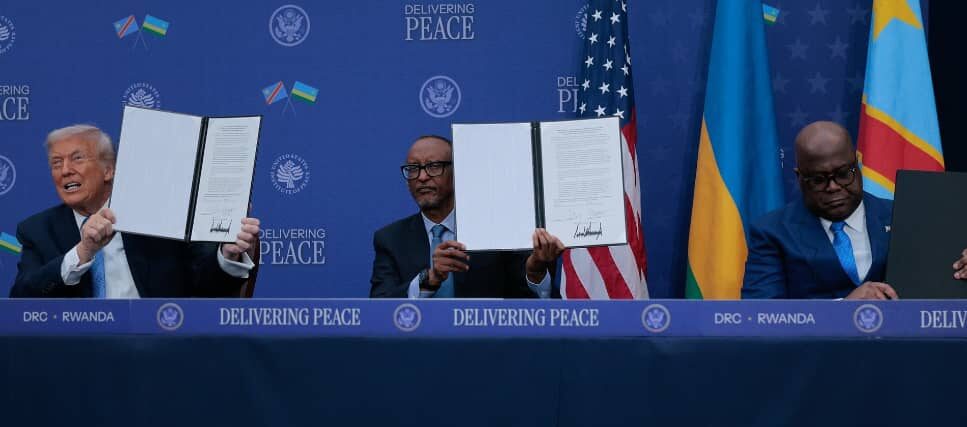
Washington, D.C. — The United States on Thursday unveiled what it called a “historic moment for peace,” as President Donald J. Trump presided over the signing of the Washington Accords, a new agreement between Rwandan President Paul Kagame and Democratic Republic of the Congo (DRC) President Félix Tshisekedi aimed at ending three decades of conflict in eastern Congo.
The ceremony — held at the newly inaugurated Donald J. Trump Institute for Peace — was accompanied by a parallel announcement: the U.S. will pursue new bilateral agreements with both nations to expand access to critical minerals essential for American clean-energy and technology supply chains.
“This is a special occasion for a lot of reasons,” Trump said as he arrived for the signing. “For more than 30 years, one of the worst conflicts on earth has been raging in Eastern Congo. Millions and millions of people have been tragically killed… today, we’re succeeding where so many others have failed.”
A Peace Deal With Heavy Lifting Ahead
The Washington Accords commit Rwanda and the DRC to a permanent ceasefire, the disarmament of non-state forces, and a framework for the safe return of refugees, alongside “justice and accountability” for atrocities committed during the conflict.
“Today, we commit to stopping decades of violence and bloodshed, and to begin a new era of harmony and cooperation,” Trump declared.
Tshisekedi expressed rare public gratitude to Washington, saying: “I would like to express, quite solemnly, our deep thanks to the President of the United States of America, Mr Donald Trump. I would like to thank his Administration, and I also wish to thank the American people.”
Kagame echoed the sentiment: “The biggest word of thanks goes to President Donald Trump. No one was asking President Trump to take up this task. Our region is far from the headlines, but when he saw the opportunity to contribute to peace, he immediately took it.”
Kenyan President William Ruto, present as a regional witness, described the agreement as “transformative, consequential, and historic.”
Minerals at the Centre of U.S. Strategy
Alongside the peace pledges, Trump announced that the United States would sign new bilateral deals unlocking access to Rwanda’s and Congo’s rare earths and other critical minerals. The U.S. has been seeking alternatives to Chinese-controlled mineral supply chains, and the DRC — home to vast cobalt, copper, coltan, and lithium deposits — is pivotal.
“Today, the United States is also signing our own bilateral agreements… that will unlock new opportunities for the United States to access critical minerals and provide economic benefits for everybody,” Trump said.
What Changes on the Ground?
Despite the pomp in Washington, analysts caution that the situation in eastern Congo remains highly unstable.
The meeting largely reinforced a peace framework first agreed in June, but since then, fighting has persisted in North Kivu and Ituri provinces, where the Rwandan-backed M23 rebel movement continues battling Congolese forces and seizing territory.
Rwanda accuses the DRC of tolerating Hutu militias linked to the 1994 genocide; Congo accuses Rwanda of fueling conflict through M23. The Washington Accords stipulate that Rwanda will end support for M23, while the DRC pledges to dismantle Hutu extremist groups on its soil.
But experts warn that implementation will be difficult.
On the ground, “people have reported continued fighting,” and many question whether either side will fully meet its obligations without sustained international monitoring.
The Accords envision new cross-border economic opportunities, including joint mineral certification and infrastructure to support U.S.-bound exports. Yet for millions in eastern Congo, the immediate concern remains security, not trade.
Peace may have been signed in Washington — but in North Kivu, it has yet to arrive.