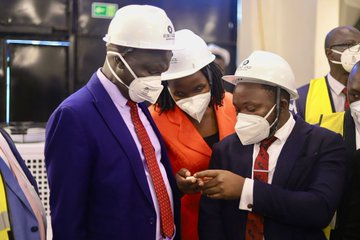
Makerere University Vice Chancellor Prof. Barnabas Nawangwe has called on African students to take charge of the continent’s technological and economic future, saying Africa’s emancipation will come not through politics, but through education, research, and innovation.
Prof. Nawangwe made the remarks during the launch of the SoonPay digital wallet app at Makerere University, an event that also featured the signing of a landmark Memorandum of Understanding (MoU) between the university and the U.S.-based fintech company.
Addressing students, the Vice Chancellor framed Africa’s current technological challenges in a historical context. He noted that Africa once shaped global civilisation but endured centuries of disruption that stunted its progress.
“In the year 711, Africans—the Moors of North Africa—invaded and occupied parts of Europe, particularly Spain. They brought advanced civilisation and building technologies. They were the first to introduce stone-building technology there. Before that, Europeans had structures similar to the mud-and-wattle buildings many of us still use today,” he said.
Prof. Nawangwe added that while Europe later adopted African knowledge, the expulsion of the Moors marked a reversal for Africa, followed by the transatlantic slave trade and colonial domination.

“For 400 years, Africans were taken away. Even after slavery ended, it was followed by 200 years of colonial rule. For a total of 600 years, Africa’s civilisation and technology were completely destroyed,” he said.
Highlighting Africa’s current demographic advantage, Prof. Nawangwe told students that the continent’s youthful population could either be a “demographic dividend” or a source of instability.
“These young people will either innovate and change Africa for the better, or destroy it if they are just waiting for jobs that are not there,” he warned. “University graduates are not supposed to wait for jobs—you are the ones expected to create them.”
He also emphasised the potential of modern technologies such as blockchain and artificial intelligence to drive Africa’s resurgence.
“Without efficient financial systems, nothing else works. Blockchain offers transparency, reduces fraud, and minimises corruption. If applied properly, it could transform how we manage finances, education, and even our natural resources, including the oil Uganda is about to exploit,” he said.
Prof. Nawangwe described Makerere students as “the cream of Africa,” placing a responsibility on them to advance Africa’s transformation through research and innovation.
SoonPay CEO Frantz Morency underscored why the company chose Uganda as its launchpad for blockchain adoption across Africa.

“As the Professor said, we have been excluded for more than 400 years,” Morency stated. “Even though we’re an American company, we know our roots. Look around the SoonPay team—you will see yourselves. We chose Uganda intentionally.”
Morency highlighted Africa’s minimal share in the global blockchain economy—just $14 million out of $4.2 billion worldwide—and said the partnership with Makerere would bridge the opportunity gap for young African innovators.
“Educate yourselves. Build. Create. Grow. Africa does not need to lose its talent,” he said.

Dr Cathy Ikiror Mbidde, Head of Makerere University Technology and Innovation Centre, called the partnership a “major milestone” and praised students for their curiosity about emerging technologies.
With the MoU now in force, Makerere University is positioning itself as a regional hub for blockchain education, research, and innovation, to empower the next generation of African tech leaders.
Prof. Nawangwe concluded: “We are lucky to be living in an era where Africa is free. I hope that we do not wait another 600 years to take advantage of this freedom. The most important resource we have is not minerals; it is human resources—you, the youth.”