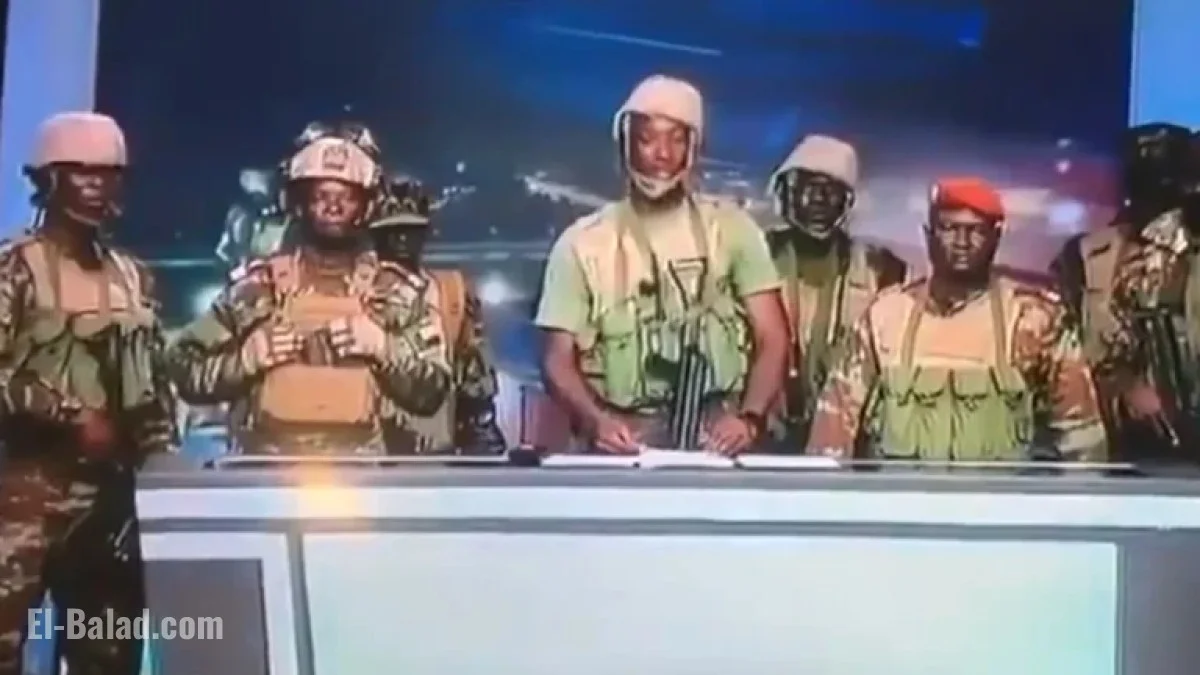
Porto-Novo, Benin — Benin was thrown into turmoil on Sunday after a group of soldiers appeared on national television announcing that they had toppled President Patrice Talon, suspended the constitution, and seized control of the country.
Led by Lieutenant Colonel Pascal Tigri, the soldiers declared that a military transition council was now in charge, hours after gunfire erupted near the president’s residence in Cotonou, the seat of government.
“In the interest of safeguarding the nation, we have decided to take responsibility for the destiny of our country,” the soldiers said in the televised statement. They accused President Talon of mismanaging the country and undermining national cohesion.
They also announced the closure of all land borders, the shutdown of Benin’s airspace, and the suspension of the constitution, measures that plunged the usually stable West African nation into uncertainty.
Government: “The situation is under control”
Despite the dramatic announcement, officials close to President Talon insisted the coup attempt was not widely supported within the military.
Foreign Minister Shegun Adjadi Bakari told Reuters that loyalist forces were already moving to regain control. “The situation is under control. A large part of the army is still loyalist — and we are taking over the situation,” he said.
A senior official at the presidency, speaking to AFP, dismissed the mutineers as a small, isolated faction: “This is a small group of people who only control the television. The city and the country are completely secure.”
The whereabouts of President Talon remain unclear.
Tension in Cotonou
Residents of Cotonou reported heavy military deployments, blocked roads, and gunfire early in the morning. The French embassy confirmed shots near the presidential residence and advised its citizens to stay indoors.
The Russian and U.S. embassies issued similar alerts, with Washington urging citizens to avoid the area around the presidential compound altogether.
A stable democracy shaken
Benin, long regarded as one of West Africa’s more stable democracies, has never experienced a successful coup in its modern history. The abrupt announcement has raised concerns across the region, already rattled by a cascade of military takeovers.
Just last week, President Umaro Sissoco Embaló was ousted in Guinea-Bissau. In recent years, militaries have seized power in Burkina Faso, Guinea, Mali, and Niger, prompting fears of democratic backsliding across West Africa.
Benin has also faced rising insecurity, with jihadist groups linked to Islamic State and al-Qaeda expanding southward into its northern regions.
Talon’s contested legacy
President Patrice Talon, 67, came to power in 2016 as a wealthy businessman nicknamed the “king of cotton.” He had promised not to seek a third term and had endorsed Finance Minister Romuald Wadagni as his preferred successor in elections scheduled for April 2026.
Though praised for stimulating economic growth, Talon’s government has faced mounting criticism for shrinking democratic space. In October, the electoral commission barred the main opposition candidate from contesting the upcoming election, citing insufficient sponsorships.
Analysts say the political tensions, combined with rising security concerns, may have contributed to the instability surrounding Sunday’s events.
Uncertain hours ahead
As night fell, Benin remained suspended between competing claims of power. Lieutenant Colonel Tigri’s faction maintained control of the national broadcaster, but the extent of their influence beyond the TV station was unclear.
Regional leaders and international observers have not yet issued formal statements, while fears grow that Benin—once seen as a model of democracy—could become the latest flashpoint in West Africa’s widening crisis of military takeovers.
The situation remains fluid.