

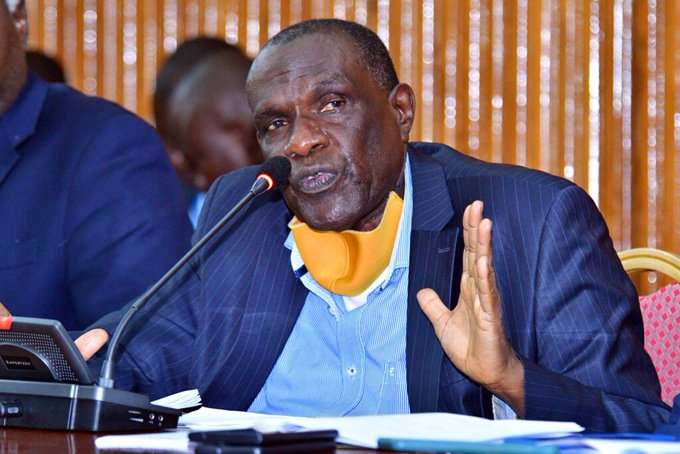
KAMPALA, Uganda — The Secretary to the Office of the President (Uganda), Yunus Kakande, has revealed that unidentified security agents allegedly took control of election operations in Ssembabule District during the January elections, after senior security and administrative officers denied knowledge of the deployment.
Kakande made the admission while appearing before Parliament’s Public Accounts Committee of the Parliament of Uganda to discuss findings of the December 2025 Auditor General’s report.
He told MPs that he had contacted both the army leadership and regional police commanders regarding security presence in Ssembabule, but received conflicting responses.
“I asked the army commander what was happening in Ssembabule. He said these were not my forces. I asked the regional police commander, but he also could not give a clear answer. You cannot allow impunity during elections,” Kakande said.
Intervention in Kassanda North Election
Kakande also disclosed that he intervened in the parliamentary election for Kassanda North Constituency, helping ensure declaration of Patrick Nsamba as winner after local electoral officials hesitated to announce the result.
He said the intervention was informed by his experience and memories of Uganda’s 1981 electoral violence, arguing that elections are highly sensitive processes that require strict adherence to results.
Nsamba later expressed appreciation, saying, “Hajji, if it was you, thank you!”
Proposal to Deploy CAOs as Returning Officers
Kakande proposed structural reforms to Uganda’s electoral management, suggesting that Chief Administrative Officers (CAOs) be appointed as returning officers at district level.
He argued that returning officers appointed by the Electoral Commission of Uganda are sometimes vulnerable to intimidation.
“Why should a returning officer allow an RDC to instruct them on whom to declare? Central control would be better if CAOs were mandated,” he said.
Criticism of Some Resident District Commissioners
Kakande acknowledged that not all of Uganda’s 146 Resident District Commissioners (RDCs) performed satisfactorily.
He cited districts including Kibuku, Buvuma, Ssembabule, and Lwengo as areas where RDC performance was questioned, noting that some officials were scheduled for transfer while others faced interdiction.
His remarks sparked mixed reactions among Members of Parliament.
Parliamentary Rejection of Transfers
Susan Mugabi, the Buvuma District Woman MP, opposed the transfer of underperforming officials instead of disciplinary action.
She argued that transferring problematic officers only relocates administrative challenges to other districts.
Similarly, Gorreth Namugga of Mawogola South rejected proposals to transfer the Ssembabule RDC, citing alleged involvement in election-related violence during local council and parliamentary polls.
Namugga also raised concerns about alleged militarisation of elections, calling for clarification on the role of security forces, including the Special Forces Command (Uganda), which she claimed influenced voter turnout in Ssembabule.
“The army took over and managed the elections… we cannot compromise governance in a democratic country,” she said.
Debate on Role of RDCs
Patrick Nsamba further argued that some RDCs operate under the perception that they are direct political representatives of the President.
He urged the Office of the President to avoid transferring problematic officials between districts, warning that such moves could spread governance challenges.
Nsamba also called for stronger oversight of land management activities linked to district administrative offices.
The Office of the President has not yet issued a formal response to the allegations regarding unidentified security deployments.
Authorities say discussions on electoral administration reforms will continue as part of broader governance reviews in Uganda.