

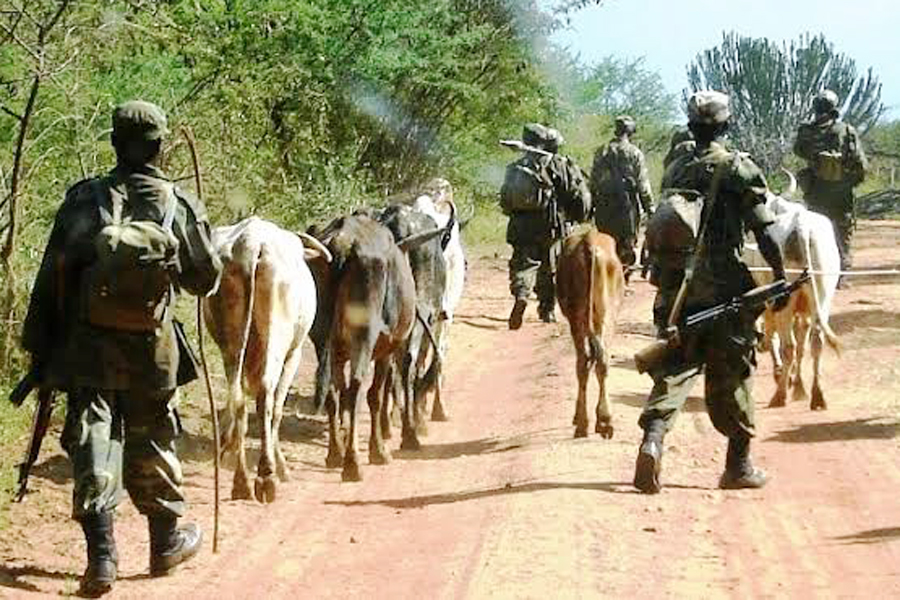
Government has allocated Shs80 billion to kick-start the long-awaited compensation of war victims in the Teso, Lango and Acholi sub-regions, Vice President Jessica Alupo has announced.
Speaking as Vice President and Katakwi Woman Member of Parliament, Alupo said the funds will support the implementation of President Yoweri Kaguta Museveni’s proposed uniform restocking plan, under which each affected household is to receive up to five cows.
The announcement comes amid growing pressure from communities in the three sub-regions, some of which have openly warned they will not support President Museveni politically unless the stalled compensation programme is fully implemented.
Opposition figure and Museveni’s rival, Robert Kyagulanyi aka Bobi Wine, promised cattle compensation in his “no cow, no vote” campaign.
Museveni pushes for inclusive, uniform compensation
President Museveni, while meeting cattle compensation claimants, local leaders and stakeholders at Soroti University in August, reiterated that the programme should benefit all households affected by past conflicts, rather than concentrating funds on a small number of claimants.
He emphasised that what has commonly been referred to as “compensation” should instead be viewed as rehabilitation, noting that the widespread loss of cattle in Teso and neighbouring regions was the result of war and insecurity.
“In the past, lawyers took a big share of this money, leaving very little for the actual beneficiaries,” Museveni said. “That is why we now insist on direct payments to households.”
The President proposed that the outstanding Shs169 billion earmarked for Teso be shared equitably among all homesteads that have not yet benefited. Using a valuation of Shs1 million per cow, Museveni explained that the funds could cover about 169,000 cows, allowing roughly 69,000 households to receive two to three cows each, while excluding the 28,000 households that have already benefited.
He added that with proper phasing and budgeting, households could ultimately receive up to five cows, as earlier proposed.
To ensure fairness and transparency, Museveni recommended the formation of inclusive committees comprising elders, youth and women leaders to harmonise distribution and oversee budgeting.
Compensation process overhauled
Deputy Attorney General Jackson Kafuuzi told the meeting that the compensation process has been fundamentally restructured to eliminate inefficiencies and corruption.
He said the government abandoned court-mediated settlements in favour of direct payments to verified claimants, with verification now conducted at sub-regional and district levels. The process involves LC1 and LC2 committees, Chief Administrative Officers, district officials and local depots, deliberately avoiding centralised verification in Kampala.
Under the new system, the Ministry of Justice issues data cards to claimants, whose biodata is verified from the village level through to the district registrars. The framework was introduced in the 2016/17 financial year, when thousands of claimants—including 16,946 across several sub-regions—were verified.
Since the launch of the Cattle Compensation Initiative in March 2022, the government has disbursed Shs506.7 billion. Recent payments in Lango alone amounted to Shs48.7 billion for 12,389 claimants, while a further Shs128.3 billion has been paid to 28,281 beneficiaries across other regions.
However, 24,509 verified claimants remain unpaid, with outstanding claims totalling Shs506.69 billion. These include Shs191.5 billion in the Northern Sub-region, Shs119.26 billion in the Eastern Sub-region, and Shs165.9 billion in the Central Sub-region. Officials attribute delays mainly to incorrect or duplicate bank details, closed accounts and mismatched identification.
Leaders call for transparency and holistic settlement
Usuk County MP Bosco Okiror urged the government to strengthen transparency and resolve pending legal disputes, citing three court cases involving claims worth about USD 207,000 annually, mostly from Teso.
He suggested that while some matters remain before the courts, negotiations and phased payments could provide faster relief. Okiror also stressed that compensation should go beyond cattle losses to address loss of life and destruction of property.
Vice President Alupo thanked President Museveni for personally engaging with communities in Teso and praised his role in restoring peace, crediting the Uganda People’s Defence Forces for stabilising the region.
Museveni endorses five-cow restocking plan
On September 17, 2025, President Museveni endorsed a consultation report on cattle compensation in Teso during a meeting at State House, Entebbe, with a select committee led by Alupo. The committee included MPs, cultural and religious leaders who had consulted widely following concerns over corruption and exclusion.
“I’m very happy with this report because it is realistic, inclusive and transformative,” Museveni said, adding that the cabinet would consider it alongside views from Lango and Acholi.
The consultations affirmed support for a uniform restocking plan of five cows per household in Teso, which has an estimated 489,000 households according to the 2024 National Population and Housing Census. An alternative proposal to provide a cash equivalent—valued at Shs1.5–2 million per cow—managed at the sub-county level was also discussed.
Museveni backed the plan, noting potential challenges with polygamous households, and proposed phased implementation to ensure affordability.
Northern Uganda-wide approach under consideration
During his campaign trail in Alebtong and Otuke districts, Museveni said the government is considering extending a flat-rate cattle compensation model across northern Uganda.
“Each household receiving five cows is a fair approach,” Museveni said, noting that leaders in Teso and Lango have endorsed the idea, while consultations with Acholi leaders are ongoing.
He reiterated that restoring livestock wealth is critical to rebuilding livelihoods destroyed by war and cattle rustling, and stressed that peace and stability remain the foundation of development in the region.
The cattle compensation programme, Museveni emphasised, is an exceptional intervention aimed at reconciliation and economic recovery in war-affected areas—not a routine government scheme.