


Human rights lawyer and civic activist Dr Sarah Bireete has drawn public attention to a new digital voter locator platform developed by young Ugandans, describing it as a civic innovation aimed at boosting voter participation ahead of the 2026 general elections.
In a social media post, Dr Bireete said the platform, branded Fanon, enables voters to locate their polling stations using two names and is available in eight languages.
She noted that the tool also displays estimated voter details at polling stations, including numbers, sex and age distribution, alongside GPS-based location mapping.
“Gen Z in Uganda have created a software for voter location in eight languages, with details of voters at each polling station and a GPS locator per polling station,” Dr Bireete said, encouraging citizens to check their details online.
She emphasised that the platform does not require a National Identification Number (NIN).
Salim Were, the co-founder of Fanon Application, says Fanon is a computer-aided voter information tool aimed at simplifying the voting process at a time when civic education has been limited ahead of the polls.
According to information displayed on the site, Fanon is not affiliated with the Electoral Commission (EC) or any political party and describes its role as “purely civic—to promote high voter turnout and to support a free and fair electoral process.”
However, the platform has already sparked debate online, with some users questioning its accuracy. One user, Twesigye Brian, said the tool incorrectly displayed his polling station. “Very misleading software, my polling station is Rweibaare 1, not Akariza,” he wrote.
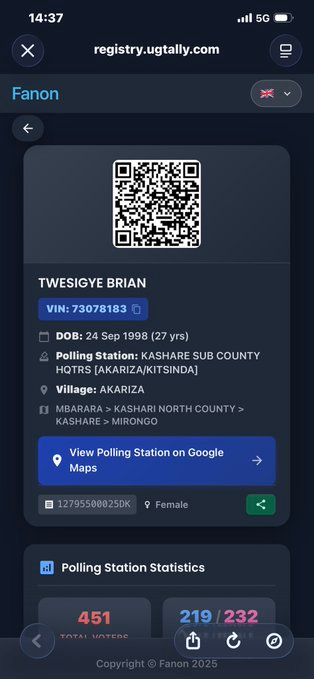
Responding to the concern, Dr Bireete cautioned users that polling station details may have changed following recent updates by the Electoral Commission. “Remember, there are changes. New 15,000 polling stations were created. Don’t be surprised. Go to the EC voter locator for confirmation,” she said.
Other users welcomed the initiative, noting its usefulness for voters who may have misplaced their identification documents. One user thanked Dr Bireete, saying the platform helped people who had lost their IDs to identify their polling stations. Questions were raised about how such voters would participate in the voting process if ID replacement is delayed.
While civic groups and digital rights activists have praised youth-led efforts to expand access to electoral information, authorities continue to urge voters to rely on official Electoral Commission tools for final confirmation. The EC operates an online voter locator and a mobile application, and has also begun issuing physical Voter Location Slips to guide voters ahead of polling day in January 2026.
As Uganda heads into a critical election period, the emergence of platforms like Fanon reflects growing youth engagement in civic processes, while also highlighting the need for verification and coordination to ensure accurate voter information under the Uganda Decides 2026 banner.