


The Uganda Revenue Authority (URA) has moved to clarify public concerns surrounding the importation of Starlink satellite internet equipment, saying the recently circulated internal directive has been widely misinterpreted.
In a statement issued on Thursday, URA Public and Corporate Affairs Manager, Robert Kalumba, said there is nothing unusual about requiring security clearance and government licensing for certain technologies and entities, particularly those linked to sensitive communications.
“There is nothing new about requesting security clearance and government licensing for certain entities and commodities,” Kalumba said. “It’s not only Uganda that asks for security clearance. It’s a worldwide practice done by many countries. So, let’s not create a storm in a teacup.”
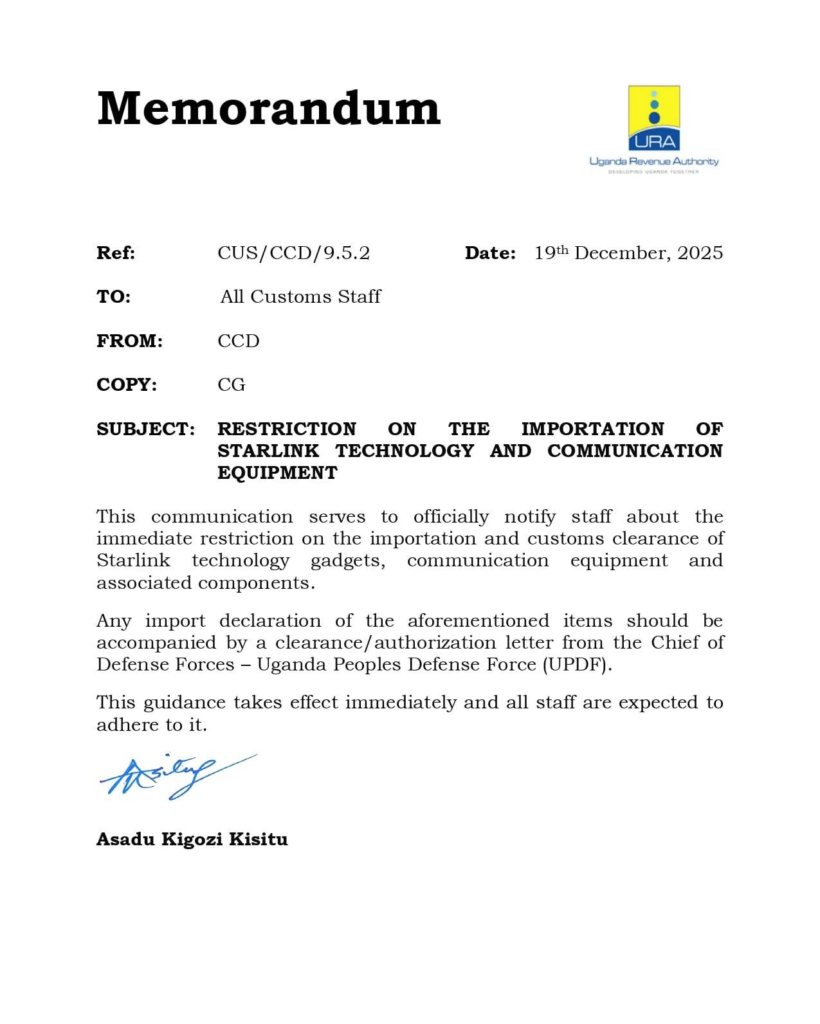
The clarification follows a leaked internal URA memorandum dated December 19, 2025, which instructed customs officials to halt the clearance of Starlink satellite internet equipment and related components until importers obtain written authorisation from the Chief of Defence Forces (CDF) of the Uganda People’s Defence Force (UPDF).
According to the memo, the directive took immediate effect, requiring importers of Starlink technologies to present formal clearance before their consignments could be released.
Kalumba explained that the measures are rooted in global best practice, noting that the importation of controlled or sensitive communication equipment is typically regulated through licensing regimes, product-specific certifications, and security vetting by customs authorities and other specialised government agencies.
“Such measures are intended to protect national security by preventing sensitive communication technologies from being misused or falling into the wrong hands,” he said.
URA emphasised that the directive does not amount to a ban on Starlink, but rather reinforces existing procedures for regulating advanced communication technologies that may bypass conventional telecommunications monitoring systems.
The issue has attracted heightened public attention due to its timing, coming just weeks before Uganda’s national elections scheduled for January 15, 2026, and amid growing demand for satellite internet services, particularly in rural and underserved areas.
The clarification also comes against the backdrop of earlier engagements between President Yoweri Museveni and Starlink representatives, during which discussions were held on expanding access to affordable internet in Uganda. However, authorities have reiterated that any rollout of such technologies must align with a “security-first” approach.
URA urged the public and importers to rely on official communication and avoid speculation, maintaining that the authority remains committed to facilitating trade while safeguarding national security interests.
The tax body said it will continue working with relevant government agencies to ensure that all imports, including emerging technologies, comply with Uganda’s legal and security frameworks.