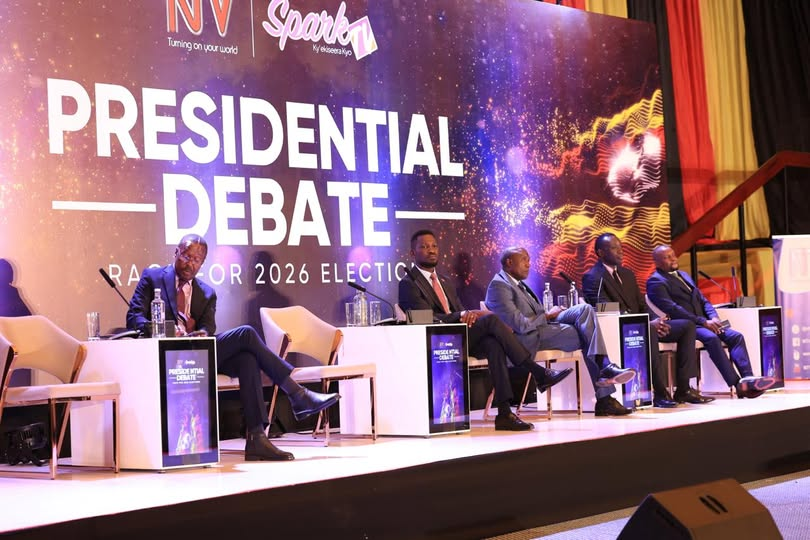

Five of the eight presidential candidates took to the stage at the 2025 NTV Presidential Debate at Serena Hotel Kampala, each seeking to persuade Ugandans that they are best suited to lead the country after the 2026 general elections.
But it was Maj Gen. Mugisha Muntu, leader of the Alliance for National Transformation (ANT), who commanded attention with a series of sharp, iconic statements that framed Uganda’s political and governance challenges with unusual clarity.
Arriving to enthusiastic applause, Muntu set the tone early with a piercing question about the nature of political power:
“What makes leaders drunk to the point where they lose direction, fail to fulfil promises, and trample on citizens?” It was a statement that echoed across social media, capturing his broader critique of leadership excesses and the erosion of public trust.
Throughout the night, Muntu—calm, deliberate, and measured—lamented Uganda’s unbroken history of leaders refusing to hand over power peacefully.
“I had hoped Uganda would break this cycle,” he said, warning that current political trends do not inspire confidence.
On security, Muntu made one of his most quoted declarations: “You cannot deal with the security problem of the country unless you deal with the political question first.”
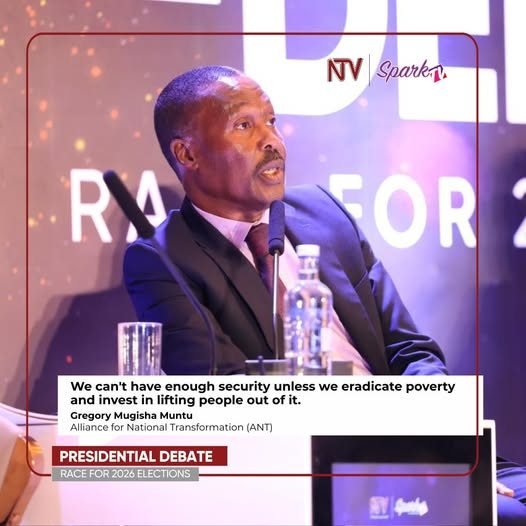
He argued that security operatives engage in unlawful behaviour because they follow “wrong orders rooted in politics,” placing the blame at the highest levels of command.
He tied Uganda’s security difficulties to its economic reality, insisting that true stability demands investment in citizens: “We can’t have enough security unless we eradicate poverty and lift people out of it.”
Muntu also highlighted inefficiencies in government public-awareness efforts, questioning why the state aggressively advertises the Parish Development Model (PDM) while many Ugandans remain unaware of the Agriculture Credit Facility, which could transform agro-processing and rural enterprise.
On the rule of law, he delivered another crisp soundbite: “We want to have leadership that operates within the law.”
His remarks on succession and Uganda’s political future resonated strongly: “We are 47 million people. Museveni is one individual. Uganda will survive beyond him—but it will require experience to guide the country afterwards.”
He warned Ugandans against expecting easy miracles: “There is no way a better future is going to fall down like rain.”
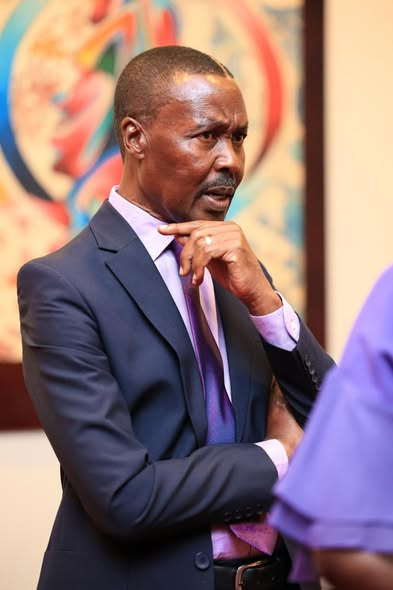
Instead, he called for collective responsibility, later reinforcing the point through ANT platforms: “A better Uganda will not fall from the sky; it requires active participation and persistence from all of us.”
The debate also touched on opposition unity. Responding to whether he would consider backing Robert Kyagulanyi (Bobi Wine), Muntu said he remained open to structured discussions, noting past moments of mass mobilisation and the potential for strategic collaboration.
His sober, issue-driven performance contrasted with the heated exchanges among other candidates, positioning him as one of the most composed, policy-focused voices of the night.
With over 1,023,000 viewers tuning in online, the debate drew one of the largest political audiences in recent memory. As Uganda heads toward the 2026 general elections, Muntu’s incisive statements now sit at the centre of public debate—raising questions about leadership, accountability, unity, and the future of Uganda after President Museveni.
Whether his call for lawful, experienced, citizen-centred leadership will sway voters in 2026 remains to be seen, but his words have undeniably shaped the national conversation.