

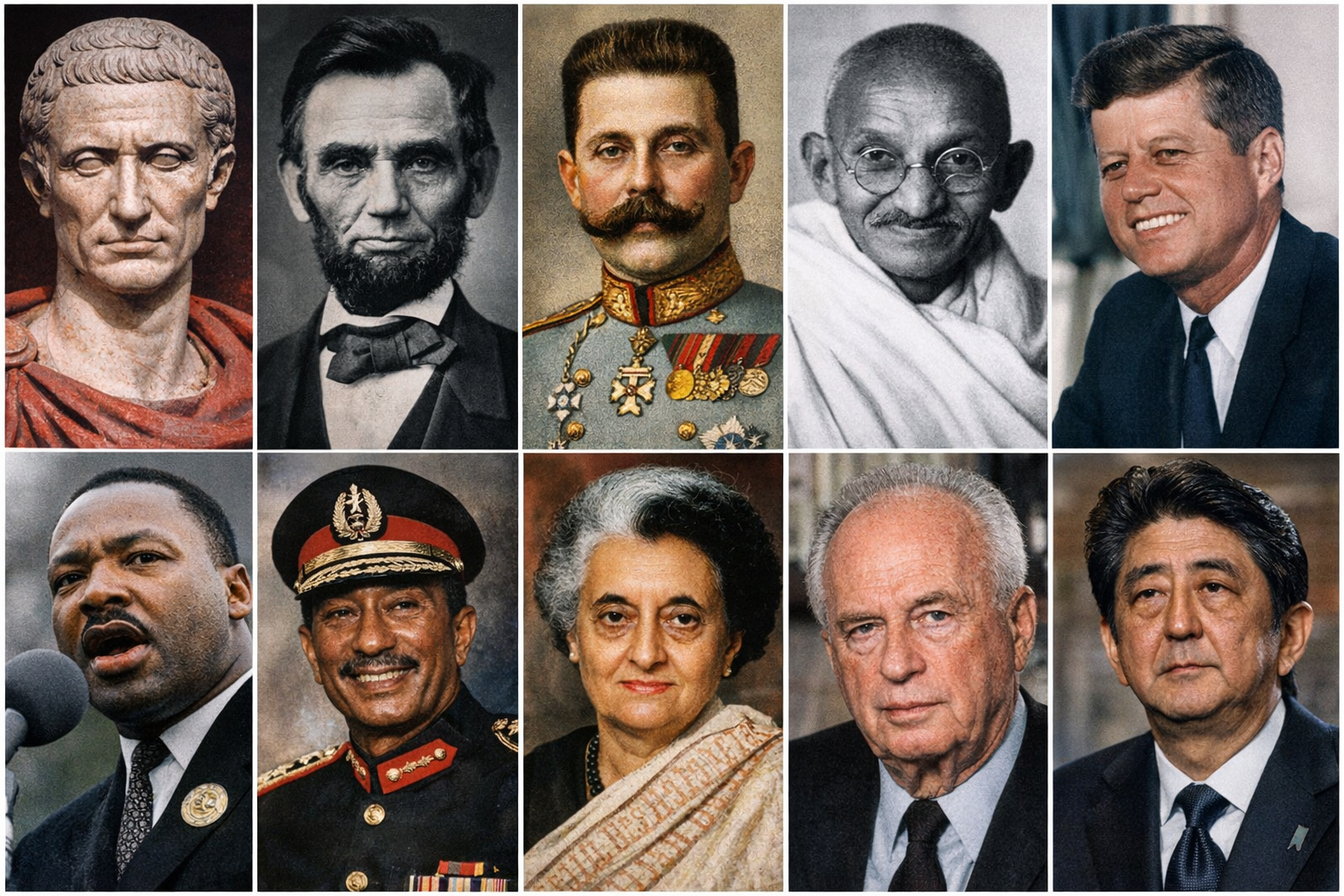
Global — Throughout history, the assassinations of prominent political figures have dramatically shaped the course of nations and international relations. From ancient Rome to the 21st century, these targeted killings not only ended lives but also altered political landscapes and inspired enduring cultural memory.
Here is a widely recognised list of iconic assassinated leaders, drawn from historical consensus and reputable sources such as Britannica, HistoryExtra, and major scholarly analyses.
The order is chronological:
• Julius Caesar (44 BC): The Roman general and dictator was assassinated on the Ides of March by a group of senators led by Brutus and Cassius, who feared his growing power threatened the Roman Republic. His killing plunged Rome into civil wars that ultimately led to the rise of Augustus and the Roman Empire, ending the republic that the conspirators sought to save.
• Abraham Lincoln (1865): The 16th President of the United States was shot at Ford’s Theatre by actor and Confederate sympathiser John Wilkes Booth just days after the Civil War ended. Lincoln’s death derailed his plans for a more lenient Reconstruction and ushered in a turbulent period marked by political conflict and racial violence.
• Archduke Franz Ferdinand (1914): The heir to the Austro-Hungarian throne was assassinated in Sarajevo by Gavrilo Princip, a Bosnian Serb nationalist linked to the Black Hand. The killing set off a chain reaction of alliances and ultimatums that ignited World War I, reshaping global politics and borders.
• Mahatma Gandhi (1948): The leader of India’s non-violent independence movement was assassinated in New Delhi by Nathuram Godse, a Hindu extremist who accused Gandhi of appeasing Muslims during the traumatic Partition of India and Pakistan. His death shocked the world and marked a turning point in post-colonial India.
• John F. Kennedy (1963): The 35th U.S. President was shot while riding in a motorcade in Dallas, Texas. Lee Harvey Oswald was officially identified as the lone assassin, though the killing spawned enduring conspiracy theories. Kennedy’s death deeply altered American politics and public trust in government.
• Martin Luther King Jr. (1968): The prominent civil rights leader was assassinated in Memphis, Tennessee, by James Earl Ray while supporting a sanitation workers’ strike. His killing sparked riots across U.S. cities but also accelerated the passage of major civil rights legislation, including the Fair Housing Act.
• Anwar Sadat (1981): Egypt’s president was assassinated during a military parade by Islamist extremists angered by his peace treaty with Israel and his crackdown on dissent. Sadat’s death underscored the risks of Middle East diplomacy and reshaped Egyptian politics under his successor, Hosni Mubarak.
• Indira Gandhi (1984): India’s prime minister was killed by her Sikh bodyguards following Operation Blue Star, a military assault on militants inside the Golden Temple. Her assassination triggered widespread anti-Sikh riots that left thousands dead and exposed deep fractures in Indian society.
• Yitzhak Rabin (1995): The Israeli prime minister was assassinated by a Jewish extremist opposed to the Oslo peace process with the Palestinians. Rabin’s death dealt a severe blow to hopes for a negotiated two-state solution and altered the trajectory of Middle East peace efforts.
• Shinzo Abe (2022): Japan’s longest-serving prime minister was fatally shot while delivering a campaign speech, in a country known for strict gun control and low violent crime. The assassination shocked Japan and the world, prompting renewed debate about political security and extremism.
This compilation prioritises leaders whose deaths had profound, lasting historical or cultural effects. Other notable figures often cited include Benazir Bhutto, Olof Palme, Rajiv Gandhi, and Rafic Hariri, highlighting the global and regional scope of political assassinations.
While no list is definitive, these cases underscore the far-reaching consequences of violence against political leaders and the enduring legacy such events leave on history.