

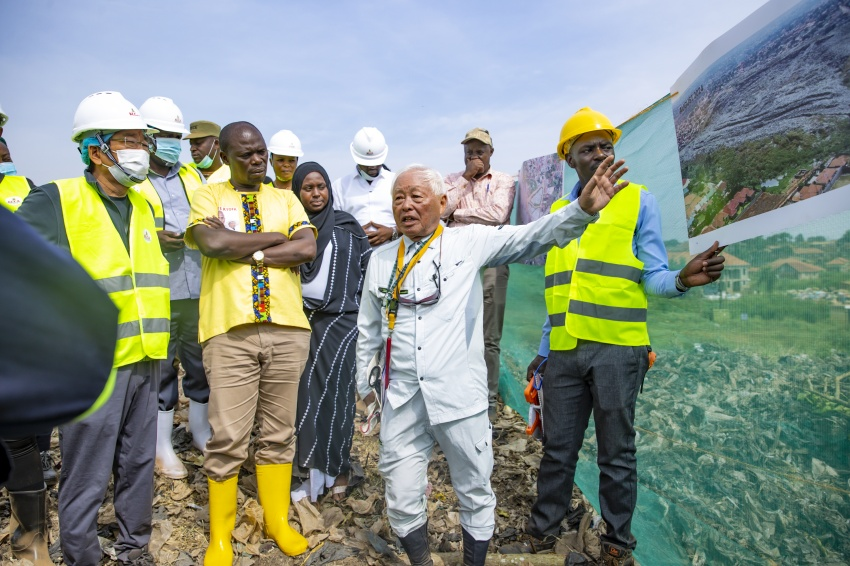
Rehabilitation works have officially begun at the Kiteezi Landfill, where heavy machinery roared to life on Thursday to clear waste and install the first gas-ventilation and leachate-collection systems.
The activity marks the start of a US$1 million project funded by the Government of Japan to stabilise and restore Uganda’s largest and most troubled waste-disposal site.
The Kampala Capital City Authority (KCCA), in partnership with UN-Habitat, launched the year-long intervention aimed at securing high-risk areas of the landfill. Parts of Kiteezi collapsed in August 2024, triggering environmental and public-health concerns for neighbouring communities. The funding was secured through a joint proposal submitted to Japan shortly after the incident.
The initiative, titled “Emergency Technical Assistance to Rehabilitate Kiteezi Landfill,” will decommission roughly 7 acres—about 250,000 cubic metres of waste—using the Fukuoka method, a Japanese landfill-engineering system designed to stabilise old sites and reduce methane emissions.
Japan’s Ambassador to Uganda, Takuya Sasayama, reaffirmed his government’s commitment to supporting Kampala’s waste-management efforts. He encouraged residents to adopt better disposal habits, including recycling and reducing household waste.
“We face waste every day, and every household must take responsibility,” he said.
Works currently underway include reshaping unstable waste slopes, strengthening the garbage mass, installing methane-ventilation infrastructure, and constructing leachate-treatment ponds. The project also involves training KCCA teams in landfill-risk management.
The technical team will be led by Japanese landfill specialist Prof. Masafumi Fujii, described by officials as one of Japan’s foremost experts in landfill engineering.
State Minister for Kampala Capital City and Metropolitan Affairs Kabuye Kyofatogabye said the intervention would reduce the likelihood of future collapses. He added that government compensation for residents affected by last year’s slide would be released soon.
Grace Lubale, UN-Habitat’s Regional Human Settlements Officer for Africa, said the project reflects the importance of international partnerships in safeguarding vulnerable urban populations. She noted that UN-Habitat will continue to guide the new waste-management facility planned for Buyala.
Representing the KCCA Executive Director, Director of Revenue Nowere said additional support would be needed to rehabilitate the remaining 30 acres of the landfill. “This grant gives us a critical start,” she said.
Local leaders, including Lusanja LCI Chairperson Kibuka, welcomed the intervention and thanked Japan for responding to long-standing community concerns.
KCCA Director for Public Health and Environment Sarah Zalwango urged residents to back the rehabilitation effort by improving waste-management practices, recycling, cutting down household waste, and avoiding littering to help steer Kampala towards a more sustainable waste-management system.