
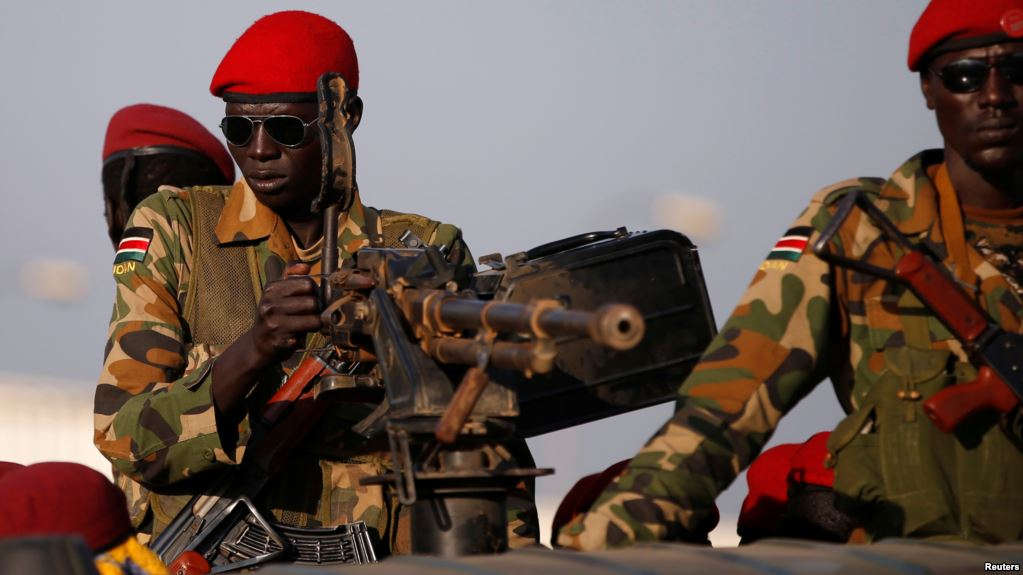
A newly released United Nations expert panel report has accused Uganda of breaching a longstanding UN arms embargo on South Sudan by deploying troops, tanks, armoured vehicles and military helicopters into the country beginning in March 2025, at the height of renewed fighting between government forces and militias loyal to former First Vice President Riek Machar.
The report, compiled by independent experts tasked by the UN Security Council to monitor sanctions against South Sudan, states that the Uganda People’s Defence Forces (UPDF) have remained in South Sudan since March under an operation dubbed “Mlinzi wa Kimya,” despite clear prohibitions under the 2018 UN arms embargo and its 2025 renewal.
“SSPDF has, however, been able to rely on the continued support of Ugandan forces, whose armed troops, tanks and armoured vehicles have remained in South Sudan since March 2025, in violation of the arms embargo established by Security Council resolution 2428 (2018) and renewed by resolution 2781 (2025),” the panel said.
Satellite imagery and video evidence reviewed by the experts reportedly confirm the presence of UPDF tanks, armoured vehicles and at least three Bell 412 helicopters, all lacking UN authorisation under the sanctions regime.
Background: Conflict and International Tension
The deployments began amid renewed hostilities in South Sudan after fighting intensified in March between forces loyal to President Salva Kiir and fighters aligned with Machar, whose indictment on serious charges has deepened political fissures and fuelled fears of a return to full-scale civil war.
Machar himself and other opposition figures have previously accused Uganda of violating the embargo by sending armoured and air units into South Sudan without proper UN approval.
The conflict traces back to the civil war that erupted shortly after South Sudan’s independence in 2011, which officially ended with a 2018 peace agreement establishing a unity government. However, tensions have frequently resurfaced, undermining political stability and complicating peace efforts.
International Concern and Human Rights Implications
The United Nations has warned that escalating violence and foreign military involvement risk unraveling the fragile peace in South Sudan. A separate UN human rights body raised the alarm in March 2025 over the dramatic deterioration of human rights protections, citing arrests of political leaders like Machar and the presence of foreign troops as elements that “increase civilian vulnerability” and threaten the peace agreement’s integrity.
UN officials have urged all parties and regional partners to prioritise diplomacy, uphold the Revitalised Peace Agreement, and ensure civilian protection as fighting continues.
Uganda’s Position and Regional Dynamics
Kampala has publicly acknowledged sending troops at the formal request of Juba’s government, arguing that the deployment was aimed at stabilising the situation and preventing further bloodshed. However, the UN panel concluded that the scale and nature of the deployment — including heavy weapons — exceed what was authorised and constitute a sanction breach.
The presence of foreign military forces near Juba and across strategic areas has complicated regional dynamics, drawing criticism from South Sudanese opposition figures and civil society groups who accuse Uganda of partisan intervention.
Broader Diplomatic Consequences
The allegations come at a sensitive time, with the UN Security Council preparing periodic reviews of South Sudan’s sanctions framework and arms embargo. The controversy over Uganda’s actions is likely to feature prominently in upcoming deliberations, raising complex questions about enforcement, sovereignty, and peace implementation.
For now, the UN experts’ findings underscore growing international concern over the peace process in South Sudan and the role neighbouring states play — whether as stabilisers or destabilising actors — in the volatile landscape of Africa’s youngest nation.