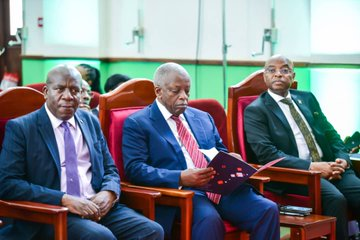

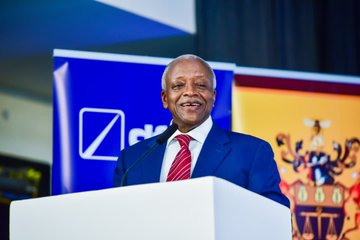
Former Prime Minister Amama Mbabazi and Bank of Uganda Governor Michael Atingi-Ego delivered powerful tributes to the late Prof. Emmanuel Tumusiime-Mutebile during the 2025 Tumusiime Mutebile Annual Public Lecture held at Makerere University, urging Uganda’s next generation of leaders to uphold the values that defined the former central bank chief’s legacy.
The lecture, hosted by the Makerere University Advancement Office, brought together scholars, economists, policy analysts, bankers, Rotarians, the Mutebile family, and students. It also featured a cultural performance by Makerere’s Department of Performing Arts and Film, where students honoured the Mukiga-born economist through a traditional Bakiga folk song accompanied by the enanga.
We are renewing our commitment—not just remembering a man
Prime Minister Emeritus Rt. Hon. Amama Mbabazi, who chairs the Board of Governors of the Tumusiime Mutebile Foundation, delivered one of the day’s most stirring reflections, recounting his long friendship with Mutebile dating back to the 1971 Makerere Guild elections.
“He was a man of courage, discipline and unshakable conviction,” Mbabazi said. “When we speak of Mutebile’s legacy, we speak of the very foundations of Uganda’s modern economy.”
Mbabazi emphasised the centrality of evidence-based policy, strong institutions, and leadership that transcends generations. “Inter-generational leadership is not an aspiration—it is a necessity,” he noted. “If Africa is to rise, we must forge leadership that blends the wisdom of experience with the creativity of youth.”
He outlined the Mutebile Foundation’s mission to strengthen private-sector capacity, reduce productivity gaps and nurture innovation. “Our task is to prepare a workforce capable of competing globally while transforming locally,” he said.
We lost a lion who roared for prudent policy
Bank of Uganda Governor Michael Atingi-Ego delivered an equally emotional tribute, calling Mutebile “a compass that guided us through economic storms.” “Three years ago, Uganda lost more than a central bank governor. We lost a lion who roared for prudent policy when silence would have been easier,” he said.
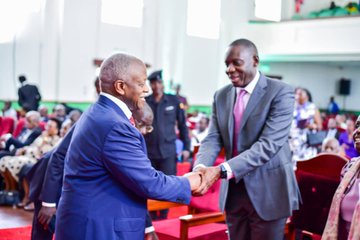
Atingi-Ego highlighted Mutebile’s leadership through three defining crises—the 2008 global financial crisis, the 2011 inflation spike, and the COVID-19 pandemic. “He restored confidence not through promises, but through action,” the Governor said. “Economic resilience begins with trust.”
A Call to Empower Uganda’s Young Leaders
Both Mbabazi and Atingi-Ego underscored the importance of integrating youth into Africa’s economic transformation.
“Africa cannot build sustainable economies while excluding its greatest resource—its young people,” Atingi-Ego said. “Experience without innovation becomes obsolescence. Innovation without wisdom becomes recklessness. Together, they become transformation.”
He credited Mutebile for expanding financial inclusion through reforms such as agency banking, Islamic banking and bancassurance.
According to the 2025 Global Findex report, 73% of Ugandan adults now have a financial account, up from 66% in 2021—progress Atingi-Ego described as “policy creating possibility.”
Innovation With Responsibility
Discussing ongoing reforms at the Bank of Uganda, Atingi-Ego highlighted new digital platforms, improved payment systems and regulatory tech enhancements—but warned against blindly embracing technology.
“Innovation without purpose is novelty. Innovation without values is danger dressed in digital clothing,” he said, citing cybersecurity, climate-related financial shocks and illicit finance as areas requiring vigilance.
Stability Alone Is Not Enough
Atingi-Ego reaffirmed that Uganda’s economy remains steady inflation: 3.6% and GDP growth: 6.3%. “But stability alone is not enough,” he cautioned. “The real question is whether we are using that stability as a foundation for bold, inclusive transformation.”
He outlined four priorities for Uganda’s future: domestic revenue mobilisation, human capital development, a deeper financial sector, and consumer-protective innovation. “We cannot build a modern economy on borrowed money alone,” he said.