

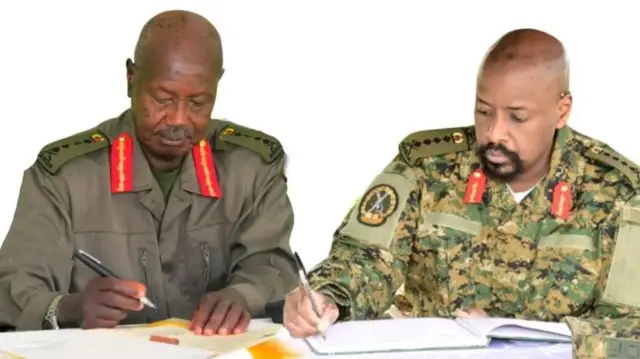
KAMPALA, Uganda — Within hours of each other, President Yoweri Kaguta Museveni and his son, Chief of Defence Forces Gen. Muhoozi Kainerugaba, made remarks that touched on two themes that have defined Uganda’s political discourse for decades: power and identity.
While President Museveni used a lecture at the Senior Staff College-Kimaka in Jinja to renew his call for East African political integration, Gen. Muhoozi Kainerugaba turned to history and ancestry, declaring himself a descendant of the legendary Bachwezi and tracing his bloodline to Jesus Christ.
Viewed separately, the statements may appear unrelated. Taken together, however, they offer a glimpse into how Uganda’s First Family continues to frame questions of leadership, legitimacy, history and the future of the region.
Muhoozi’s Bachwezi Claim
Gen. Muhoozi ignited debate after posting on X:
“I am a descendant of the Great Bachwezi! They will ALWAYS rule Uganda!”
He followed up with another post stating:
“Our bloodline starts with Jesus Christ. It runs through Mzee Kabuguma, he produced Mzee Amos, who produced Mzee Museveni. Who produced me.”
The comments immediately sparked reactions across social media, with supporters interpreting them as an expression of cultural pride and historical identity, while critics viewed them as reinforcing perceptions of dynastic politics.
The Bachwezi occupy a unique place in the history and folklore of the Great Lakes region. Traditionally associated with prosperity, cattle-keeping, state formation and spiritual authority, they are remembered as a ruling dynasty whose influence stretched across parts of present-day Uganda centuries before colonialism.
Although historians continue to debate the historical and mythical dimensions of the Bachwezi, references to them carry significant symbolic weight in many communities.
For supporters of Gen. Muhoozi, the remarks reinforced a narrative of continuity and destiny. For critics, they raised questions about whether modern political leadership should be linked to lineage and ancestry.
Museveni’s Call for a Larger Political Future
Almost simultaneously, President Museveni was looking beyond ancestry and toward geography.
Addressing senior military officers in Jinja, he argued that East Africa’s future prosperity and security depend on deeper political integration.
The President warned that regional unity would remain elusive if leaders prioritize national prestige over collective progress.
“We have been talking about East African integration, but if Presidents want to remain big fish in small ponds, then that issue will not be addressed,” President Museveni said.
For decades, Museveni has been one of the strongest advocates of an East African Federation, arguing that fragmented markets and colonial-era borders limit Africa’s economic and strategic potential.
In his latest remarks, he linked integration not only to economic growth but also to future security challenges, including technological competition and geopolitical influence.
“That’s why the answer there is political integration,” he said.
Two Narratives, One Question
The timing of the two statements has prompted discussion about the different ways power is being framed within Uganda’s political establishment.
Muhoozi’s message draws legitimacy from history, ancestry and cultural identity. Museveni’s vision derives legitimacy from political integration, economic transformation and Pan-Africanism.
One looks backward to a celebrated historical legacy; the other looks forward to a future regional state.
Yet both narratives share a common theme: continuity.
For President Museveni, continuity lies in completing what he describes as Africa’s unfinished project of political and economic integration.
For Gen. Muhoozi, continuity appears rooted in historical lineage and the idea of an enduring connection between past and present leadership.
A Debate Beyond Uganda
The two narratives also touch on broader debates unfolding across Africa.
Can modern states build legitimacy through historical and cultural identity while remaining democratic and inclusive?
Can political integration succeed when national leaders remain reluctant to surrender elements of sovereignty?
And how should future generations interpret the relationship between traditional authority, historical memory and modern governance?
These questions are likely to remain central as East Africa continues discussions about federation and regional integration while also grappling with questions of leadership succession and political legitimacy.
The Road Ahead
Neither President Museveni nor Gen. Muhoozi explicitly connected their remarks to Uganda’s future leadership. Yet the statements have inevitably attracted attention because of their source.
President Museveni remains one of Africa’s longest-serving leaders and a vocal champion of East African unity. Gen. Muhoozi remains one of Uganda’s most influential public figures and is frequently discussed as a potential future political leader.
Whether viewed as historical reflection, political philosophy or strategic messaging, the comments have reignited debate about who should lead, how power should be justified and what shape the future of East Africa should take.
In one message, the conversation was about the legacy of the Bachwezi. In the other, it was about the dream of an East African Federation.
Together, they reveal a continuing struggle over how history, identity and political ambition will shape the next chapter of Uganda and the wider region.