

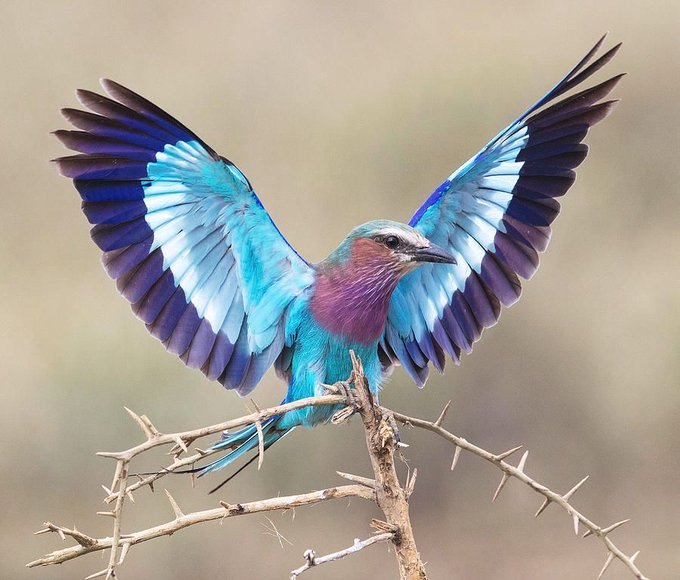
In the golden savannas of Uganda’s national parks and wildlife reserves, there is a resident that consistently steals the spotlight without saying a word.
Draped in a breathtaking palette of lilac, turquoise, and royal blue, the Lilac-breasted Roller is a favourite for any lens—but it’s their private lives that are currently catching the eye of the Uganda Wildlife Authority (UWA).
From acrobatic courtship dives to their choice of high-rise nesting spots, UWA is pulling back the curtain on the domestic habits of this winged icon, proving there is much more to this bird than just a pretty face.
In a public awareness message, UWA said the lilac-breasted roller (Coracias caudatus) typically lays between two and four eggs, which are incubated by both parents for about 22 to 24 days. The chicks then leave the nest roughly 19 to 20 days after hatching.
Unlike many birds that construct their own nests, the species relies on natural tree cavities or abandoned nesting holes previously used by other birds.
“Instead of building nests, they use abandoned woodpecker or kingfisher holes or natural tree cavities,” the authority explained.
UWA also noted that the bird is highly territorial during the breeding season and aggressively protects its nesting sites from predators such as eagles and falcons.
The lilac-breasted roller, known for its striking mix of lilac, turquoise, green and blue feathers, is a monogamous species widely distributed across sub-Saharan Africa.
In Uganda, the bird can be found in several protected areas including Lake Mburo National Park, Queen Elizabeth National Park, Murchison Falls National Park, and the flood-savannah plains of Pian Upe Wildlife Reserve in northeastern Uganda.
According to the International Union for Conservation of Nature, the lilac-breasted roller is currently classified as “Least Concern,” meaning the species is not considered at risk of extinction.
Wildlife authorities say raising public awareness about such species helps promote conservation and encourages more people to explore Uganda’s diverse birdlife, which is among the richest in Africa.