

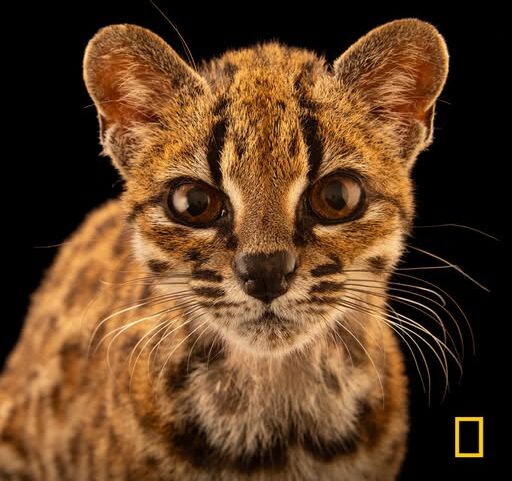
Scientists have identified a previously unknown wild cat species in Bolivia’s Yungas cloud forests, marking the first time in more than a century that a completely new living cat species has been formally described.
The small, spotted feline has been named Leopardus tilcayo, retaining the name used by local communities in Bolivia’s Yungas region. The findings were published this week in the journal Current Biology.
The discovery began in 2016 when Bolivian biologist and National Geographic Explorer Paola Nogales-Ascarrunz received a call from a wildlife sanctuary about what staff described as a “weird cat.”
A local man had found the animal as a kitten near a forest road and initially took it home believing it was a domestic cat. As it grew, its unusual appearance became apparent and it was eventually taken to the sanctuary, where it remains in protective care.
The animal is about 46 centimetres long and weighs roughly 1.4 kilograms, making it smaller than an average domestic cat. It has light-brown fur marked with large, irregular spots and belongs to the group of small wild cats commonly known as tiger cats.
Genetic evidence reveals a separate species
Although the animal had been known locally, its status remained uncertain until scientists conducted detailed genetic research.
Researchers analysed genetic material from 38 cats collected from different parts of South America. The analysis showed that the Bolivian animal represents a distinct evolutionary lineage that separated from its closest relatives about 1.4 million years ago.
The research also changed scientists’ understanding of the South American tiger-cat group. What had previously been treated largely as a single species was found to contain five distinct species, according to the study. Researchers also identified a new subspecies in Peru, Leopardus tigrinus antisuyo.
The discovery is significant because it is not simply a case of scientists changing the classification of an animal that was already recognised as a species. Leopardus tilcayo had never previously been formally described as a distinct living cat species.
The last completely new living feline species formally described by scientists was the pampas cat in 1923, according to researchers and scientific publications.
Local name retained
The scientific name also carries a record of local knowledge.
Communities in the Yungas have long referred to the animal as Tilcayo, and researchers chose to retain the name when formally describing the species. Nogales-Ascarrunz told National Geographic that when researchers asked local people why they called it Tilcayo, one response was that their grandfather had used the name.
Researchers from Bolivia’s Universidad Mayor de San Andrés (UMSA) were also involved in the work. The university said preliminary genetic analyses were carried out through its molecular genetics laboratory and that the research involved Bolivian scientists Nogales-Ascarrunz and Enzo Aliaga Rossel.
Much remains unknown
Despite the formal identification of the species, scientists know little about the Tilcayo’s life in the wild.
So far, its presence has been genetically confirmed in Bolivia’s Yungas forest ecoregion, which lies along the eastern slopes of the Andes. Researchers are still trying to determine the animal’s full geographic range, population size, diet, reproductive behaviour and habitat requirements.
The Yungas ecosystem also faces pressure from deforestation, agriculture, fires and mining, raising concerns about the species before scientists have established how many individuals survive in the wild.
Researchers are using camera traps in the Yungas in an effort to find additional Tilcayos in their natural habitat. National Geographic reported that the only known individual currently identified is receiving long-term care at the Senda Verde wildlife sanctuary.
The discovery has also raised a broader question for wildlife researchers: if modern genetic tools can reveal a completely new cat species in a region that has been studied for decades, how many other animals remain scientifically unrecognised?
The researchers say the methods used in identifying Leopardus tilcayo could help uncover additional hidden diversity among small wild cats in other parts of the world.