

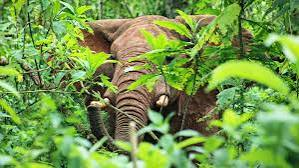
African elephants in Kenya’s Mount Elgon region may deliberately seek out medicinal plants when they are sick, according to a new study based on observations from people who have lived and worked alongside the animals for decades.
The study, published on September 24 in Scientific Reports, documented 35 plant species and four types of soils, minerals or clays that local experts associated with possible medicinal behaviour among the elephants. Researchers caution that the evidence is based largely on eyewitness accounts and does not by itself prove that the plants medically treat particular conditions.
Researchers interviewed eight members of the Sabaot community, including wildlife scouts, guides and elders. All had spent more than 20 years living in or working around Mount Elgon and had extensive experience observing the local elephant population.
Of the 35 plants identified, local informants said 25 were used by elephants for medicinal purposes. Eight were classified by researchers as particularly strong cases of possible self-medication: the plants were reportedly sought by visibly sick or vulnerable elephants for specific therapeutic purposes, or administered to their young.
Among the plants identified were Aloe arborescens, Bersama abyssinica, Coleus barbatus, three species of Dombeya, Ficus natalensis and Kuloa usambarensis.
Some accounts involved mother elephants apparently treating their calves.
Researchers were told that elephant mothers chew plants including Coleus barbatus, Ficus natalensis and Bersama abyssinica, sometimes mixing the material with their milk before giving it to their young. Local observers described the practice as a form of “immunisation.”
One of the plants, Coleus barbatus, locally known as Angurweet, was reportedly used by elephant mothers in mixtures given to calves. Researchers said the accounts were sufficiently unusual to warrant further investigation rather than being treated simply as ordinary feeding behaviour.
The study also reported elephants travelling considerable distances to particular plants without stopping to feed on other vegetation along the way. Such behaviour, researchers said, could indicate that the animals were selectively seeking particular resources rather than simply foraging randomly.
The researchers use the term zoopharmacognosy to describe the study of animals selecting and using natural substances for medicinal purposes.
Mount Elgon provides a particularly useful setting for such research because of its rich plant diversity and the elephants’ well-documented use of caves containing mineral- and clay-rich deposits. The elephants are known to enter the caves and scrape mineral material from the walls with their tusks.
The research also found an overlap between elephant behaviour and traditional human medicine in the area. Of the 39 natural resources identified in the interviews, 34 were said by informants to have traditional medicinal uses among people.
That overlap raises another question: whether some human knowledge of medicinal plants may itself have been informed by watching animals.
Researchers said some local informants believed people had learned about particular medicinal plants by observing elephants and other animals use them. The study found that several plants frequently associated with elephant medicinal behaviour also have documented traditional medicinal uses and reported pharmacological properties.
The researchers, however, stress that interpreting medicinal behaviour in wild animals is difficult. The findings are based on the observations and indigenous knowledge of eight people rather than controlled medical experiments on elephants.
To gather stronger evidence, researchers have begun providing local wildlife experts with cameras to document elephant behaviour in the field. They are also analysing some of the plants used by elephants to determine whether they contain compounds with potential medicinal properties.
The findings also raise conservation concerns. If elephants deliberately seek particular plants when sick, destruction or fragmentation of their forest habitat could remove resources that are important not only to the animals but potentially to communities that have traditionally used the same plants.
As the study puts it, the findings suggest that African elephants may possess a more diverse medicinal repertoire than previously recognised. The larger question may be older than modern medicine itself: how much of what humans call medical knowledge began with watching other animals survive?