

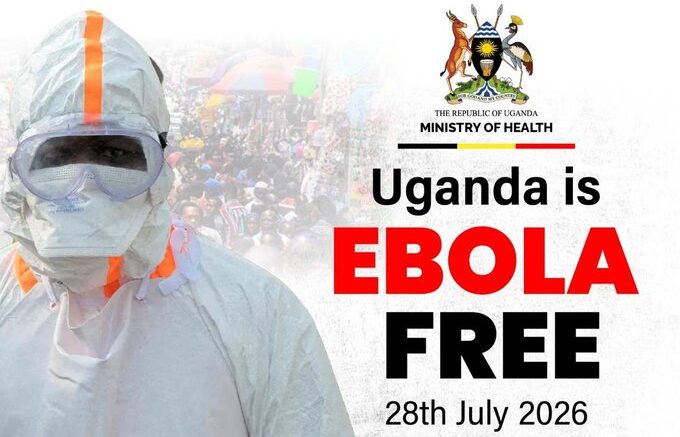
KAMPALA — Uganda has officially declared itself Ebola-free, bringing to an end the country’s latest outbreak after health authorities confirmed that all patients had recovered and no new cases had been detected following months of intensive surveillance.
The declaration was made by the Minister of Health, Dr. Chris Baryomunsi, who said Uganda had successfully interrupted transmission of the Ebola virus following a coordinated national response.
“Uganda is officially #EbolaFree,” Dr. Baryomunsi announced.
According to the Ministry of Health, the declaration follows the discharge of the last Ugandan patient on June 16, 2026, and comprehensive surveillance that found no evidence of further community transmission.
Unlike previous outbreaks that required the standard 42-day waiting period after the last confirmed case, the Ministry explained that the 2026 outbreak resulted from a fully documented importation event, allowing authorities to accurately trace and contain the virus.
“The source of infection was identified, the route of introduction established, all confirmed cases were epidemiologically linked, transmission chains were completely characterised and reconstructed, and all identified contacts were institutionally quarantined and completed the mandatory 21-day follow-up without evidence of further transmission,” the Ministry said in a statement.
Health officials added that enhanced surveillance throughout the monitoring period detected no unexplained Ebola infections in communities.
The outbreak began in May 2026, when imported cases of the Bundibugyo ebolavirus entered Uganda from the Democratic Republic of the Congo (DRC). During the outbreak, Uganda recorded 20 confirmed cases, including two deaths among the imported patients, while 18 people recovered.
The Ministry attributed the successful containment to rapid case detection, laboratory testing, contact tracing, institutional quarantine and coordinated efforts by national and district health teams.
Dr. Baryomunsi also credited Uganda’s experienced outbreak response teams and the government’s continued investment in epidemic preparedness, saying lessons learned from previous Ebola outbreaks enabled authorities to respond swiftly and effectively.
Uganda has built a strong reputation for managing viral haemorrhagic fever outbreaks through robust surveillance systems, community engagement and rapid emergency response. The country’s public health system has previously contained multiple outbreaks of Ebola and Marburg virus disease.
Despite declaring the outbreak over, the Ministry of Health urged Ugandans to remain vigilant because the Democratic Republic of the Congo continues to report Ebola cases.
Health officials encouraged members of the public to seek immediate medical attention and report anyone experiencing symptoms such as sudden fever, vomiting, diarrhoea, unexplained bleeding or severe weakness.
The World Health Organization welcomed Uganda’s successful response, noting that rapid detection, effective contact tracing and strong cross-border surveillance were instrumental in stopping further transmission.
The declaration marks another significant public health achievement for Uganda, reaffirming the country’s capacity to detect, contain and eliminate deadly infectious disease outbreaks while strengthening preparedness for future health emergencies.