

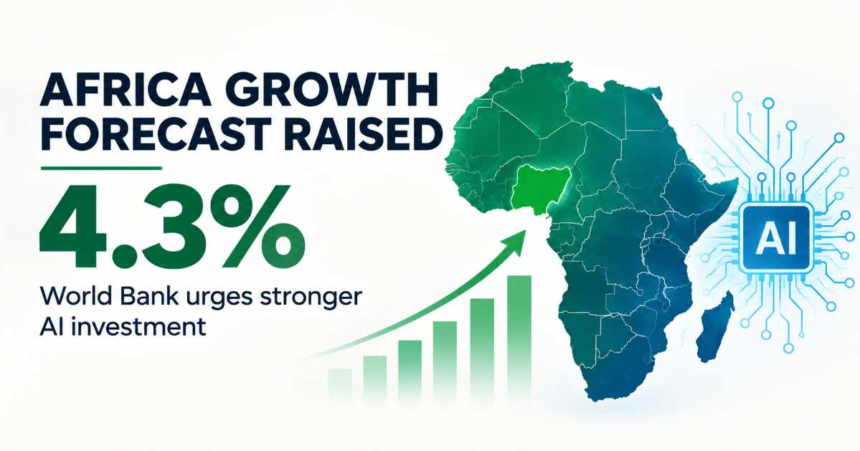
The World Bank has raised its economic growth forecast for Sub-Saharan Africa in 2026 to 4.3%, citing stronger economic performance across the region and urging governments to invest in artificial intelligence to improve productivity and create jobs.
The revised forecast, contained in the World Bank’s latest Africa Economic Update released on October 6, is 0.3 percentage points higher than the bank’s April projection of 4.0%. Growth is also expected to accelerate from 4.1% recorded in 2025. World Bank
The bank said growth forecasts had been upgraded for nearly three-quarters of countries in the region, with Angola, Ethiopia, Nigeria and Zambia among those recording improved projections.
Andrew Dabalen, World Bank Chief Economist for Africa, said the stronger performance reflected improved macroeconomic resilience, domestic demand and investments associated with the global energy transition and digital technologies.
“Economic activity in Sub-Saharan Africa continues to demonstrate remarkable resilience, with growth forecasts upgraded for nearly three-quarters of countries in the region,” Dabalen said.
However, the bank warned that the stronger headline growth has not yet translated into sufficient poverty reduction or employment opportunities for Africa’s rapidly growing population.
Per capita income growth is expected to reach only 1.8% in 2026, up from 1.6% in 2025, according to the report. Reuters
“The next challenge is turning growth into more jobs and better opportunities,” Dabalen said.
AI as a growth opportunity
The World Bank has placed artificial intelligence at the centre of its recommendations for sustaining growth and improving productivity across the region.
The bank said African countries do not need to compete with wealthier economies in building the largest AI models or data centres. Instead, it recommends adopting and adapting affordable AI applications to local needs in areas such as education, agriculture, health, finance, logistics and public administration.
The report says AI could complement rather than replace workers in the near term, particularly in developing economies where much employment remains concentrated in manual work.
It identifies applications such as helping farmers make better production decisions, supporting medical screening, improving teaching and automating accounting and other tasks for small businesses as potential areas for productivity gains.
For Africa to benefit, however, the bank said governments must first address gaps in electricity, internet connectivity, digital skills, data and computing infrastructure.
The bank also called for stronger institutions, data protection and regional cooperation to support responsible AI adoption.
Risks remain
Despite the improved growth outlook, the World Bank warned that the region remains exposed to geopolitical tensions, climate shocks, disease outbreaks, tighter global financial conditions and high debt-servicing costs.
Public debt has broadly stabilised at about 57% of GDP, but the bank said high debt-service costs continue to restrict government spending on health, education and infrastructure.
Inflation is also projected to rise from 3.7% in 2025 to 5.5% in 2026, partly because of higher global fuel, food and fertiliser prices.
The bank said the central challenge for African governments is therefore no longer simply achieving economic expansion, but converting that growth into higher productivity, more employment and improved living standards.
The latest update argues that investments in AI readiness, alongside sound economic management and stronger infrastructure, could help African economies address some of the productivity and employment pressures created by the continent’s rapidly expanding labour force.