
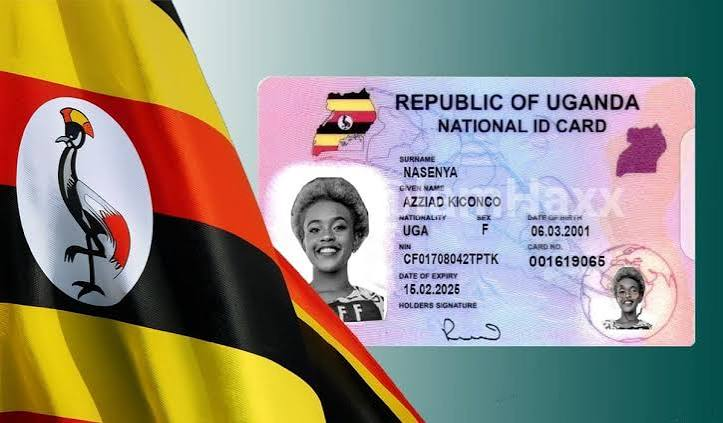
KAMPALA — Ugandans seeking passports, banking services and other transactions are facing verification challenges following the introduction of a new electronic identification system that requires service providers to authenticate National Identification Numbers (NINs) using biometric information.
The National Identification and Registration Authority (NIRA) says the new verification framework, introduced in May 2025, was designed to strengthen identity security and prevent fraud involving stolen, altered or falsified national identity cards.
However, implementation has been slower than anticipated, with only 10 of the 107 partner institutions having completed onboarding and begun transacting through the new system as of October 28, 2026.
The challenges came into focus after a Ugandan, Godfrey Kuteesa, raised concerns on X about difficulties encountered when using his newly issued national identity card to access government services.
Kuteesa said he had been sent back to NIRA by the Ministry of Foreign Affairs when seeking passport services, after presenting his new national identity card.
He questioned why government institutions could not access a common database to verify information already held by NIRA.
“This country! NIRA told us to re-register to get new IDs. When you go to Foreign Affairs to get a passport and present the new ID, they send you back to NIRA to get a confirmation letter that they indeed gave you the new ID,” he wrote.
He also raised concerns about reports that some transactions were failing because newly issued NINs were not reflecting in certain systems.
Responding to the concerns, NIRA’s Registrar and Public Relations Officer, Claire Ollama, said the difficulties were partly a result of changes in how identity verification is conducted under the new National Security Information System.
Ollama explained that the system requires service providers to retrieve customer information directly from NIRA’s database using a person’s NIN and biometric identifiers, such as fingerprints or iris scans.
Under the previous arrangement, verification largely depended on information presented on the physical identity card.
“The ID document becomes secondary proof of your identity,” Ollama explained.
She said the change was introduced after reports of stolen national identity cards and cases in which photographs on genuine cards were altered and used to obtain loans in other people’s names.
Biometric authentication is intended to ensure that the person seeking a service is the legitimate holder of the identity being presented.
According to Ollama, a service provider captures a customer’s fingerprint or iris at the point of service and matches it against biometric information collected by NIRA during registration.
Once the identity is confirmed, the institution can retrieve the person’s particulars from the National Identification Register in their presence and with their consent.
She also cited the growing use of artificial intelligence in creating convincing identities of non-existent people as another reason for strengthening biometric verification.
“In the age of AI where non-existent persons can be generated by technology to near perfection, the risk of creating a KYC profile based on a synthetic person is mitigated by supply of a fingerprint from a warm body,” she said.
Only 10 partners fully onboarded
Despite the security objectives, the transition has exposed gaps in technological preparedness among institutions expected to use the system.
Ollama said NIRA shared integration guidelines with all 107 partner institutions in April 2026 through its third-party interface, enabling them to begin preparations for electronic Know Your Customer (eKYC) verification.
However, by October 28, only 10 partners had completed onboarding and were actively transacting through the platform.
In September, NIRA specifically wrote to all 30 commercial banks, giving them an October deadline to prepare for integration.
“However, this is still pending for a majority of them,” Ollama said.
She said the authority had made its Partner Management Platform available and remained willing to support institutions seeking to connect to the system, but maintained that the responsibility for technological readiness rested with the individual partners.
The Uganda Bankers’ Association has also indicated that some financial institutions are still testing their connections, while others are in the process of procuring or installing compatible biometric readers.
This means that although NIRA’s verification infrastructure is available, many institutions have not completed the upgrades required to use it.
Temporary arrangements
To minimise disruptions during the transition, NIRA says it has introduced alternative verification arrangements for institutions that are yet to complete integration.
These include secure email-based verification, which the authority provides at no cost to partner institutions, as well as Confirmation of Information Letters issued for specified recipients and purposes.
Ollama advised customers whose new identity cards cannot be verified at service points to ask the relevant institution whether it can authenticate their details through NIRA’s secure email channel or accept a Confirmation of Information Letter.
Citizens requiring assistance can contact NIRA through its toll-free line, 0800 211 700.
The challenges have also revived questions about coordination between government agencies, particularly where citizens are required to move between institutions to confirm information that should ordinarily be accessible through interconnected government databases.
The concerns place renewed attention on the government’s wider digital transformation agenda: whether the systems being developed by individual public institutions can communicate effectively enough to deliver seamless services to citizens.
For now, NIRA maintains that the new verification system is operational, but its effectiveness in everyday transactions will depend on how quickly banks, telecommunications companies and government agencies complete their integration.