

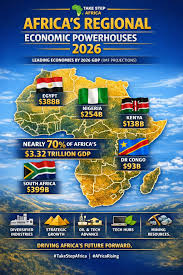
Africa’s economic landscape is taking clearer shape in the latest 2026 projections, with Egypt and Nigeria emerging as the continent’s largest economies by purchasing power, according to data consistent with the International Monetary Fund World Economic Outlook released in April 2026.
The figures, which reflect Purchasing Power Parity (PPP) adjustments, show how Africa’s economic weight is increasingly driven by population size, domestic consumption, and structural diversification rather than exchange rate valuations alone.
At the top of the ranking is Egypt, projected at approximately $2.53–$2.57 trillion, placing it 18th globally. Nigeria follows closely with $2.39–$2.42 trillion, ranking 19th worldwide.
South Africa remains the continent’s third-largest economy at roughly $1.06–$1.07 trillion, maintaining its position as a key industrial and financial hub despite slower relative growth compared to the top two.
Behind the leading trio, Algeria ranks fourth with an estimated $915.8–$941.5 billion, followed by Ethiopia, which continues its rapid expansion at $530.8–$558.9 billion.
Morocco and Kenya remain closely matched in the mid-tier group, with Morocco at $457.5–$469.4 billion and Kenya at $430.3–$435.2 billion, reflecting East Africa’s growing economic influence driven by services, agriculture, and technology sectors.
Angola follows at $417.2–$423.9 billion, while Tanzania is projected at $317.9–$320.9 billion. Ghana completes the top ten with an estimated $314.6–$325.4 billion.
Economists note that PPP rankings provide a more realistic picture of domestic economic activity compared to nominal GDP, as they account for differences in cost of living and local purchasing power.
The latest projections confirm a significant shift in Africa’s economic centre of gravity, with North and West Africa maintaining dominance at the top, while East Africa continues to steadily close the gap through diversified growth.
Egypt’s rise to the top is attributed to its large population base, diversified industrial structure, and expanded infrastructure investment. Nigeria’s strong position reflects its vast consumer market and continued dominance in sectors such as oil, agriculture, and services.
However, analysts caution that these are projections for 2026 and may shift depending on global commodity prices, political stability, exchange rate movements, and domestic reforms across the continent.
Still, the data underscores a broader narrative: Africa’s economies are expanding in scale and complexity, with multiple regional powerhouses shaping the continent’s long-term growth trajectory.