

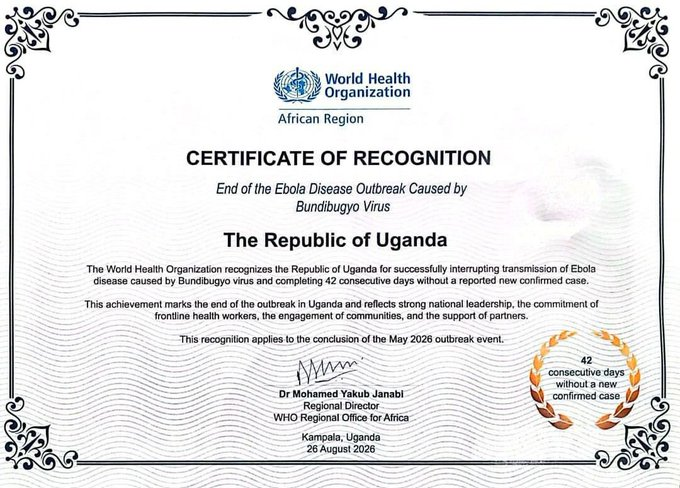
Uganda has officially ended its 2026 Ebola outbreak after completing a 42-day monitoring period without detecting a new case, marking a major public health milestone for the country.
WHO Director-General Dr Tedros Adhanom Ghebreyesus congratulated the Ugandan government, health workers, communities and other partners involved in the response, saying the country’s experience demonstrated the importance of preparedness, surveillance and careful management of borders during outbreaks.
“I congratulate Uganda’s government, and all involved in the response, for passing the 42 day monitoring period with no cases of Ebola,” Tedros said.
He said countries could continue allowing people and goods to move while protecting public health by strengthening preparedness, surveillance and management of points of entry.
Uganda declared the outbreak on May 15, 2026, after confirming cases of Ebola disease caused by the Bundibugyo virus. The outbreak was epidemiologically linked to transmission in the Democratic Republic of Congo (DRC), with imported infections subsequently producing secondary transmission among contacts and health workers.
According to WHO, Uganda recorded 20 confirmed cases, including two deaths, while 18 patients recovered. Fifteen of the confirmed cases were imported from the DRC, while five were locally acquired among contacts and health workers linked to imported infections. More than 800 contacts were identified and monitored during the response.
The last confirmed Ugandan case was identified on June 21. The final patient was discharged from care on July 16 after testing negative for Ebola twice, triggering the 42-day countdown required before the outbreak could be declared over. WHO describes the period as equivalent to two maximum incubation periods for Bundibugyo virus disease.
Uganda subsequently announced the interruption of local transmission on July 28. Surveillance and other response measures continued through the remainder of the monitoring period to ensure that no undetected transmission remained.
The outbreak had initially raised fears of wider regional transmission because of Uganda’s extensive movement of people and goods across its border with the DRC. WHO had declared the outbreak a Public Health Emergency of International Concern on May 17, citing the growing outbreak in the DRC and the risk of international spread.
At the time, Uganda’s first confirmed cases were imported from the DRC. WHO later documented secondary infections among contacts and health workers, although it found no evidence of sustained community transmission.
The successful containment is therefore being presented not simply as the absence of cases, but as evidence of the value of early detection and rapid response.
WHO Regional Director for Africa Dr Mohamed Janabi described the development as “a victory for Uganda and an important lesson for our continent.”
“We must now protect this achievement while accelerating the response in the DRC. We will only be secure when transmission is stopped everywhere,” Janabi said.
WHO also praised Uganda’s continued investment in preparedness, warning that ending an outbreak does not eliminate the possibility of future importation.
The warning is particularly relevant because Ebola transmission remains active in the DRC. WHO reported that the DRC outbreak had grown substantially during the period in which Uganda was containing its own cases, illustrating the difficulty of treating infectious disease as a problem confined by political borders.
The organisation has urged Uganda and other countries in the region to maintain surveillance, testing capacity, rapid investigation of alerts, infection-prevention measures and community engagement.
WHO has also advised against travel or trade restrictions linked to the outbreak, saying countries should keep borders and movement open while applying proportionate public-health measures.
For Uganda, the declaration closes another chapter in a country that has repeatedly faced Ebola outbreaks. But the geography of the latest outbreak offers a harder lesson: a virus does not recognise the border posts, customs offices and national flags that humans use to organise their world.
Uganda may have stopped Ebola transmission within its borders. The regional threat, however, remains tied to what happens next door.