
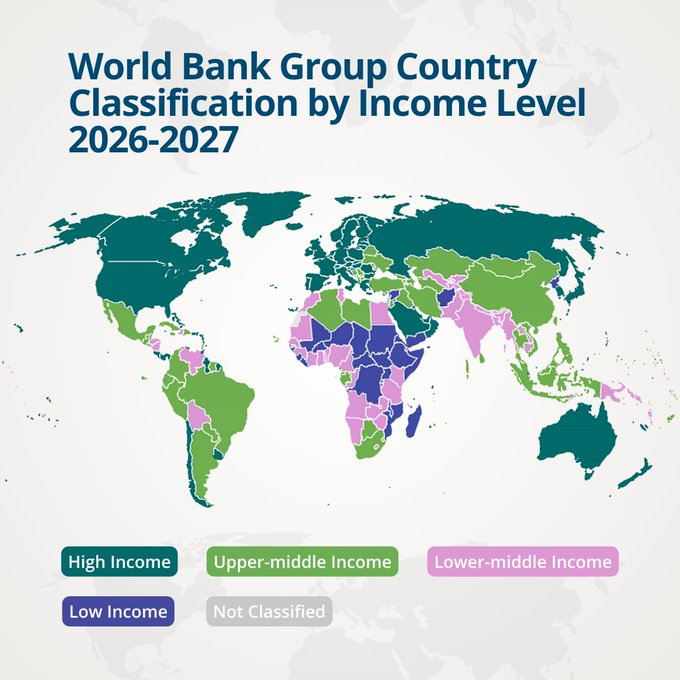
KAMPALA — Uganda remains in the World Bank’s low-income category while Kenya and Tanzania retain their lower-middle-income status in the latest classification of economies, underscoring the uneven pace of economic progress across East Africa.
The World Bank’s 2026–2027 Country Income Classifications, released on July 1, place economies into four groups according to gross national income (GNI) per capita: low-income, lower-middle-income, upper-middle-income and high-income.
For the 2027 fiscal year, which runs from July 2026 to June 2027, the World Bank defines low-income economies as those with GNI per capita of $1,175 or less, lower-middle-income economies as those between $1,176 and $4,635, and upper-middle-income economies as those between $4,636 and $14,375. Economies above $14,375 are classified as high-income.
Uganda is classified as low-income, alongside Rwanda, Burundi and South Sudan in the East African region. Kenya and Tanzania are classified as lower-middle-income.
No East African country moved into a higher income category in the latest annual update.
Uganda remains in low-income group
For Uganda, the classification means the country remains below the World Bank’s $1,176 threshold for lower-middle-income status.
The World Bank’s current country database lists Uganda as a low-income economy and an IDA country, meaning it remains eligible for financing from the International Development Association, the World Bank’s concessional lending arm for the world’s poorest countries.
The classification is based on 2025 GNI per capita, rather than simply the size of the economy or its GDP growth rate.
This distinction is important for Uganda, which has continued to report economic growth but has also experienced rapid population growth. GNI per capita measures national income relative to population, making population dynamics an important factor in determining where an economy falls on the World Bank scale.
The World Bank cautions that GNI per capita does not by itself measure living standards or overall development. However, it uses the indicator because it is broadly comparable across economies and is closely associated with a number of development outcomes.
Kenya and Tanzania hold lower-middle-income status
Kenya remains in the lower-middle-income category, with the World Bank also classifying it as an IDA Blend country.
Tanzania is also classified as lower-middle-income. The country moved into that category in 2020 after previously being classified as low-income.
The position puts Kenya and Tanzania one income group above Uganda, Rwanda and Burundi under the World Bank’s current framework.
The difference is significant for East Africa because the region contains economies at different stages of the income transition despite their close geographic and economic links.
Rwanda remains low-income
Rwanda remains classified as a low-income economy, despite its rapid economic growth over the past two decades.
The country is also listed among the World Bank’s IDA economies.
Its continued low-income classification illustrates one of the limitations of judging economic transformation solely through growth rates. A country can expand rapidly while remaining below the per-capita income threshold because population growth and the starting level of income also matter.
Burundi, another member of the East African Community, likewise remains in the low-income category.
Six countries move up globally
While East Africa recorded no upward movement this year, the global classification produced six promotions.
Togo moved from low-income to lower-middle-income, while Jordan, Micronesia, the Philippines, Sri Lanka and Vietnam moved from lower-middle-income to upper-middle-income. No economy moved down to a lower income category.
The World Bank says the six cases demonstrate that countries can cross the same income thresholds through very different routes.
Vietnam’s upgrade was driven by strong export-led growth, with exports increasing by more than 15% in both 2024 and 2025 and GDP growth of 7% and 8% respectively.
Sri Lanka’s promotion followed an economic recovery after its severe 2022 crisis, while Jordan’s reclassification was helped by a revision of its national accounts that showed the economy was nearly 10% larger than previously estimated.
Togo’s movement into the lower-middle-income group was particularly notable because a reduction in its estimated population following the 2022 census substantially increased its income per person. Its GDP also grew by 5.9% in 2025.
What the classification means for Uganda
The World Bank updates its income classifications every July using the previous year’s GNI per capita. The methodology uses the Atlas method, which converts national income into US dollars while smoothing the effect of short-term exchange-rate fluctuations. The thresholds are also adjusted annually for inflation.
The classification has practical implications beyond the label.
Income categories are used by governments, researchers and international institutions to compare economic progress and help determine eligibility for different forms of development financing and assistance.
For Uganda, remaining in the low-income category means the country continues to sit among the world’s poorest economies by the World Bank’s per-capita income measure, despite years of economic expansion.
The East African picture is therefore mixed: Kenya and Tanzania are lower-middle-income, while Uganda, Rwanda and Burundi remain low-income.
And while the World Bank’s latest rankings provide a snapshot of where the region stands, the more important question for countries such as Uganda is how quickly rising national output can translate into higher income per person and eventually push the economy across the next threshold.