

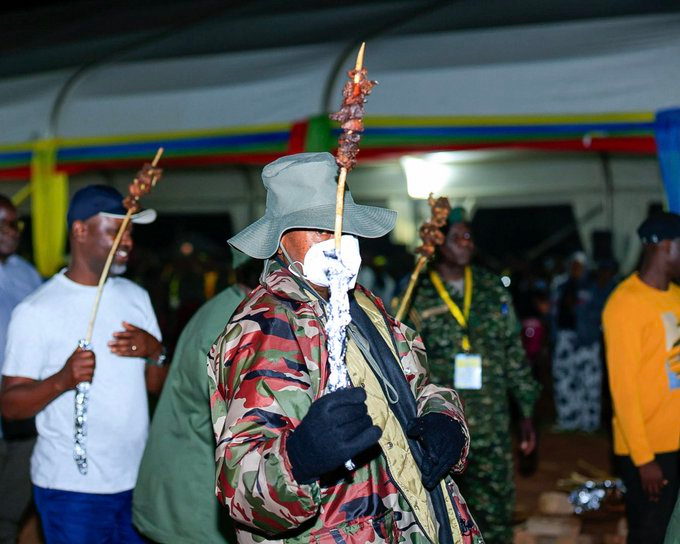
KYANKWANZI — President Yoweri Kaguta Museveni has issued a stern warning to corrupt officials, declaring that those involved in graft “are now in danger,” as he used the National Resistance Movement (NRM) retreat to rally leaders around integrity, patriotism, and national transformation.
“The corrupt are now in danger and will be dealt with. You cannot underestimate us. You will see what will happen,” President Museveni said, urging Members of Parliament to reject bribery and lead by example.
“You in Parliament are now on the frontline. You should not accept bribes. If you have problems, come and tell us, but don’t take bribes,” he emphasised, warning that culprits risk losing their seats.
The President made the remarks on the seventh day of the NRM retreat at the National Leadership Institute (NALI), where he also laid the foundation stone for the Gen. (Rtd) Caleb Akandwanaho (Salim Saleh) School of Research and the Walter Rodney Block.
Museveni Hails Saleh’s Patriotism
During the ceremony, President Museveni paid tribute to retired General Caleb Akandwanaho, describing him as a symbol of sacrifice and patriotism for dedicating his youth to Uganda’s liberation struggle.
“People like Saleh should act as good examples to you young people to show you what patriotism means and how what you do can help your country,” he said.
The President recounted that Gen. Saleh joined the fight against Idi Amin in 1976 at just 16 years of age after leaving school in Kako and travelling to Tanzania alongside other fighters such as Ivan Koreta.
“Between 1979 and 1986, he did a lot of good work, especially during the 1981–1986 war. Saleh commanded many of the big battles, including Masindi, Kabamba, Masaka, and Kampala,” he noted.
He added that after the war, Gen. Saleh shifted his focus to economic transformation and wealth creation, particularly in agriculture and development initiatives.
“That development in Kapeka was started by Saleh. I am very glad that this is a good idea, and I commend you,” President Museveni said.
Research School to Advance Ideology and Pan-Africanism
The new facility at NALI will serve as a hub for ideological training, research, and Pan-African studies. NALI Director Okei Rukogota said the complex will promote African culture, ideological engagement, and digital learning.
“It will be an arena for musevenomics studies and will honour Gen. Saleh’s contribution—from mobilisation during the war to the implementation of economic transformation programmes,” he said.
The facility will also house a revolutionary museum to preserve Uganda and Africa’s liberation history.
Call for Patriotism and Accountability
Head of Public Service Lucy Nakyobe called for renewed patriotism among public servants, warning that corruption in recruitment and service delivery threatens national development.
“Corruption is growing under our watch, and if we do not stop it now, it will become a monster that will destroy the country,” she cautioned.
She revealed that government has introduced mandatory ideological training at NALI for new public servants and senior officials to instill discipline and national values.
Health Sector Updates
Health Minister Jane Ruth Aceng highlighted progress in the health sector, including expanded mental health services and advances in organ transplant procedures at Mulago National Referral Hospital.
“So far, Mulago has carried out over 12 transplant surgeries, and all recipients and donors are alive and well,” she said.
She also emphasized disease prevention as key to reducing the burden on the healthcare system.
Push for Unity and Integration
On regional issues, President Museveni stressed the importance of African unity and economic integration, paying tribute to leaders such as Julius Nyerere and Benjamin Mkapa for their role in advancing the East African Community.
“We cannot achieve prosperity with fragmented markets, policies, and infrastructure,” he said, calling for deeper regional integration.
The NRM retreat has brought together newly elected MPs and senior officials to reflect on governance, discipline, and national priorities, as the ruling party positions itself for the next phase of leadership.