

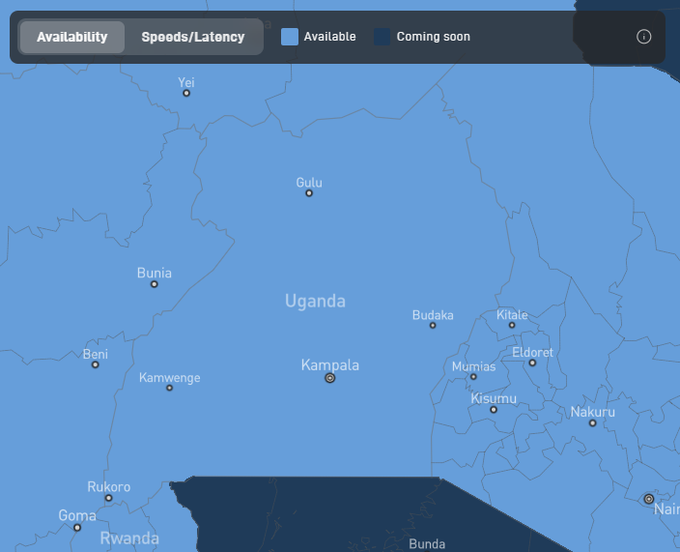
KAMPALA — Starlink has officially launched its high-speed satellite internet service in Uganda, ending months of regulatory uncertainty and opening a new chapter in the country’s internet market.
The Elon Musk-owned company announced that its “high-speed, low-latency internet is now available in Uganda,” with residential customers now able to order equipment and subscribe directly.
The launch follows a May 2026 agreement between Starlink and the Uganda Communications Commission (UCC), witnessed by President Yoweri Kaguta Museveni at State House, Entebbe.
President Museveni said the government’s priorities were “security, revenue assurance, and proper accountability” in the telecommunications sector.
Under the licensing framework, Starlink is required to establish a national gateway, maintain a physical presence in Uganda and comply with local regulatory, taxation and data-governance requirements. UCC said the licence also allows Starlink to share infrastructure with other licensed operators, particularly to expand services in underserved areas.
Starlink’s arrival is expected to increase competition in Uganda’s internet market, particularly in areas where fibre and mobile networks remain limited.
But the service enters the market at a relatively high cost for ordinary households.
Starlink’s Residential 100 Mbps package is listed at Shs203,704 per month, while the estimated initial payment for the standard hardware, regulatory fee and shipping is about Shs2.3 million.
The pricing has already prompted comparisons with existing home internet services offered by MTN Uganda and Airtel Uganda.
Starlink’s biggest potential advantage, however, may not be in Kampala, where fibre and mobile broadband are already widely available, but in rural and hard-to-reach communities where laying conventional infrastructure can be expensive.
The technology uses a network of low-Earth-orbit satellites to provide broadband without relying on terrestrial fibre connections, making it particularly suited to remote locations.
Uganda had previously seen Starlink terminals operating without formal authorisation, prompting regulatory action before the company secured its operating framework. UCC had repeatedly stressed that satellite operators must obtain approval before providing services in the country.
The formal launch now shifts the question from whether Starlink can operate in Uganda to whether it can make satellite internet affordable and widely accessible.
For businesses, schools, health facilities and communities beyond reliable terrestrial networks, the service could provide an important alternative. But with an upfront cost running into millions of shillings and a monthly subscription above many existing broadband options, its ability to close Uganda’s digital divide will ultimately depend on who can afford to use it.