

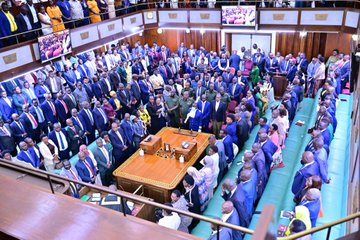
KAMPALA — Parliament has approved an increase in the number of ministers, paving the way for the implementation of President Museveni’s newly announced Cabinet for the 2026–2031 term.
The motion, tabled by Prime Minister Robinah Nabbanja, was passed overwhelmingly with 320 Members of Parliament voting in favour, six against and two abstaining. The approval raises the constitutional ceiling on Cabinet Ministers from 21 to 30 and Ministers of State from 21 to 51.
The move aligns the law with President Museveni’s recently announced appointments and formally regularises the structure of the new Executive. Under the approved arrangement, Uganda’s government will comprise 30 Cabinet Ministers and 51 Ministers of State, bringing the total number of ministers to 81.
While presenting the motion, Prime Minister Robinah Nabbanja told Parliament that the changes were necessary to address growing administrative demands and support effective government service delivery. She argued that the approved numbers largely reflect positions that were already operational and would help eliminate overlaps created during government rationalisation efforts.
The approval comes days after President Museveni unveiled his new Cabinet, retaining several key figures in senior government positions. Vice President Jessica Rose Epel Alupo and Prime Minister Robinah Nabbanja both retained their offices, while Janet Museveni was reappointed Minister of Education and Sports.
Among the notable changes in the new Cabinet is the appointment of Rebecca Kadaga as First Deputy Prime Minister and Minister for East African Community Affairs. Dr Crispus Kiyonga was named Second Deputy Prime Minister and Deputy Leader of Government Business, while Lukia Nakadama retained her position as Third Deputy Prime Minister and Minister without Portfolio.
The expansion generated debate in Parliament, with opposition legislators arguing that a larger Executive would place an additional burden on taxpayers at a time of competing national priorities. Government supporters, however, maintained that the expanded team would improve coordination, supervision and implementation of government programmes.
The approval marks one of the largest executive structures in Uganda’s recent history and clears the way for the new administration to begin implementing its development agenda for the next five years.