

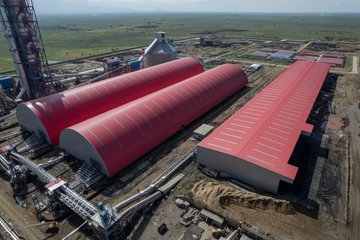
MOROTO — President Yoweri Kaguta Museveni has commissioned the $300 million Yaobai clinker cement factory in Nadunget, Moroto District, marking a major milestone in Uganda’s push for industrialisation and import substitution.
The facility, developed by Chinese investors under Yaobai International, features East Africa’s largest clinker production line with a capacity of 6,000 tonnes per day. The project also includes a grinding plant in Jinja, strengthening the country’s cement value chain.
Speaking at the commissioning, President Museveni said the factory will significantly reduce Uganda’s reliance on imported clinker, which has historically accounted for the bulk of cement production costs.
“Old factories used imported clinker for cement production, losing about 85 percent of the value abroad,” the President said. “Uganda has been spending about $260 million on clinker imports. We are now no longer dependent on these imports.”
He emphasised that clinker should not be taxed, citing government policy aimed at supporting investors in their early years.
“According to government policy, in the first ten years of investment in Uganda, a company does not pay tax even if it makes profits,” he said. “Clinker should not be taxed.”
President Museveni also pointed to the vast natural resources in Karamoja, particularly limestone deposits, as a key driver of the region’s transformation into an industrial hub.
“There are many raw materials here, including limestone, with 67 million tonnes confirmed and 108 million tonnes estimated,” he noted. “If you are not careful, those who do not move first may find that Karamoja has overtaken them.”
In a reflective tone, the President invoked a biblical reference to underscore the region’s changing fortunes.
“As the Bible says, the last shall be first,” he said, in reference to Karamoja’s transition from one of Uganda’s least developed regions to a centre of industrial growth.
Officials said the factory is expected to boost local production, create jobs, and strengthen Uganda’s position as a regional supplier of cement to neighbouring markets, including South Sudan, western Kenya, and the Democratic Republic of Congo.
The commissioning was also attended by representatives from the Chinese Embassy in Uganda, who described the project as a symbol of growing cooperation between Uganda and China in industrial development.
“This marks another example of cooperation between China and Uganda in innovation, industrial development, and capacity building,” the embassy said in a statement.
The launch of the Yaobai plant increases the number of cement producers in Uganda and aligns with the government’s broader strategy to promote value addition and reduce dependence on imports.
Government officials say the project will play a key role in lowering construction costs, improving infrastructure development, and advancing Uganda’s long-term economic growth agenda.