

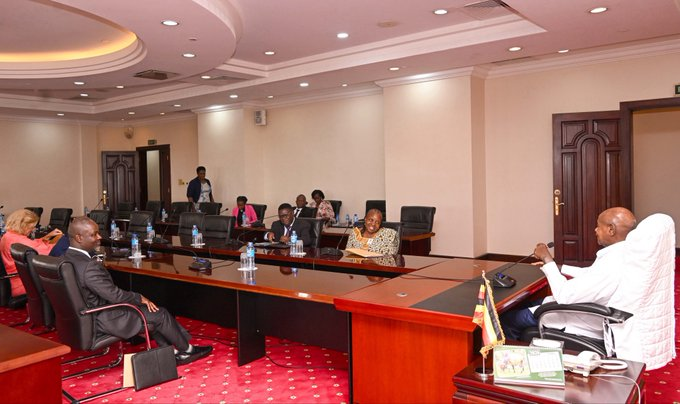
President Yoweri Kaguta Museveni has endorsed Ugandan lawyer Rosette Muzigo-Morrison’s candidacy for a judgeship at the International Criminal Court (ICC), as Uganda seeks to retain its representation on the international judicial body.
President Museveni received Muzigo-Morrison at State House Entebbe on Monday, November 23, 2026, where he expressed support for her bid ahead of the ICC judicial elections scheduled for early December.
In a message shared on his official X account, President Museveni said: “Today, I received Ms. Rosette Muzigo Morrison at State House Entebbe. She is representing Uganda in the race for a judgeship at the International Criminal Court (ICC). I wish her good luck.”
Muzigo-Morrison is seeking one of six judicial positions expected to be filled during the December elections. She is contesting under List B, which covers candidates with recognised competence in international law, including human rights and humanitarian law.
She brings more than three decades of experience in international criminal law and human rights, including involvement in international justice processes relating to Rwanda and Sierra Leone.
Her election would see her succeed Justice Solomy Balungi Bossa, the Ugandan judge currently serving at the ICC, whose tenure is coming to an end.
The meeting at State House was attended by several senior government officials, including Deputy Speaker of Parliament Thomas Tayebwa, Justice Minister Norbert Mao and Uganda’s Permanent Representative to the United Nations, Ambassador Adonia Ayebare.
Muzigo-Morrison’s candidacy comes at a time when Uganda’s relationship with the ICC has attracted political debate, particularly over previous calls by some government officials for the country to reconsider its membership of the court.
Uganda is among the countries that ratified the Rome Statute, the treaty that established the ICC in 2002. The court investigates and prosecutes individuals accused of genocide, crimes against humanity, war crimes and the crime of aggression.
Her bid is therefore significant for Uganda’s continued participation in the international justice system and its representation in one of the world’s principal institutions for prosecuting serious international crimes.
The ICC has 18 judges, elected by the Assembly of States Parties for nine-year, non-renewable terms.