

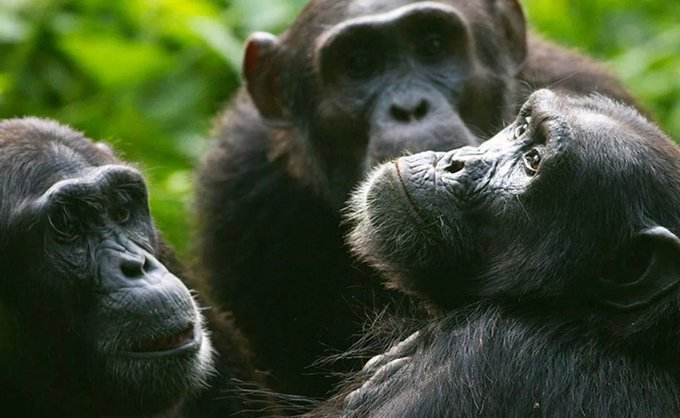
The Uganda Wildlife Authority has highlighted the remarkable intelligence and social behaviour of chimpanzees, describing the primates as among the closest living relatives to humans and a key part of Uganda’s rich biodiversity.
Speaking about the importance of chimpanzee conservation, Bashir Hangi, Head – Communication and Public Relations at UWA, said chimpanzees continue to provide scientists and conservationists with important insights into human evolution, behaviour and social interaction.
Hangi noted that chimpanzees share nearly 99 percent of their DNA with humans, making them one of the most intelligent animal species on earth alongside bonobos.
According to him, chimpanzees demonstrate advanced problem-solving abilities and regularly use tools in their natural habitats. He explained that the primates use sticks to collect termites, stones to crack nuts, leaves to absorb water and branches for protection.
He added that chimpanzees also display complex social characteristics including forming friendships, building alliances, recognising social hierarchies and communicating through vocal sounds and gestures.
Hangi said the animals are capable of showing empathy by comforting distressed members within their groups and have demonstrated signs of self-awareness.
He further explained that different chimpanzee communities develop distinct learned behaviours that are passed on from one generation to another, which researchers consider a form of culture in the wild.
Uganda is home to significant populations of chimpanzees found across several forest ecosystems and protected areas.
These include Kibale National Park, Budongo Forest, Kyambura Gorge, Kalinzu Forest, Bugoma Forest, Semuliki National Park, Bwindi Impenetrable National Park, Toro-Semliki Wildlife Reserve and Rwenzori Mountains National Park.
Conservationists say protecting chimpanzee habitats remains critical amid increasing threats from deforestation, habitat fragmentation and human activity.