

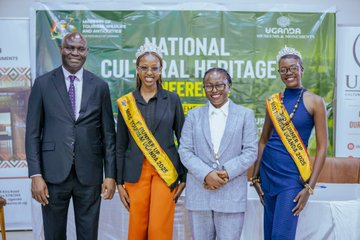
Uganda’s built heritage took centre stage on Tuesday as policymakers, conservationists, and architects gathered in Kampala for the third National Cultural Heritage Conference, coinciding with African World Heritage Day.
Held at Fairway Boutique Hotel, the conference was organised under the theme “Urbanisation Without Erasure: Architectural Heritage in Uganda’s Changing Urban Centres,” highlighting growing concern over the loss of historic buildings in rapidly expanding cities such as Kampala and Jinja.
Heritage under pressure
Speakers warned that unchecked urban development is threatening Uganda’s architectural identity, with older structures increasingly being replaced by modern high-rise buildings.
Architect and conservation advocate Nahinda Benghani pointed to the challenges of maintaining historic properties, citing Masindi Hotel—a century-old landmark—as an example of sites struggling to remain viable amid changing economic realities.
“These buildings are not just structures; they carry history and identity,” Benghani noted, calling for stronger incentives to support their preservation.
“Irreplaceable storytellers”
Heritage expert John de Coninck emphasised that historic buildings serve as “irreplaceable storytellers” of Uganda’s past, warning that once demolished, their cultural value cannot be recovered.
The conference heard that while modernisation is inevitable, it should not come at the cost of erasing cultural memory embedded in architecture.
Defining Uganda’s future cities
In one of the most thought-provoking moments, Dr Bashir Atuheire challenged participants to reflect on the direction of urban development.
“What kind of cities do we want—ones of glass and steel, or those with memory and soul?” he asked, prompting debate on how Uganda can balance development with heritage conservation.
Calls for restoration over demolition
Participants widely agreed on the need to prioritise restoration and adaptive reuse of historic buildings rather than demolition. They also called for improved coordination between government agencies, private developers, and cultural institutions.
The event, supported by stakeholders including the Ministry of Tourism, Wildlife and Antiquities Uganda and the Uganda Tourism Board, urged policymakers to strengthen legal and financial frameworks to protect heritage sites.
Global context
The discussions aligned with global advocacy led by UNESCO, which marked African World Heritage Day by emphasising the importance of safeguarding the continent’s cultural and historical assets for future generations.
By the close of the conference, participants issued a unified call to integrate heritage preservation into urban planning policies. Delegates stressed that Uganda’s development should reflect both progress and identity, ensuring that modernisation enhances rather than erases the country’s cultural landscape.
As cities continue to grow, the conference concluded that preserving architectural heritage is not just about protecting old buildings, but about sustaining Uganda’s story for generations to come.