

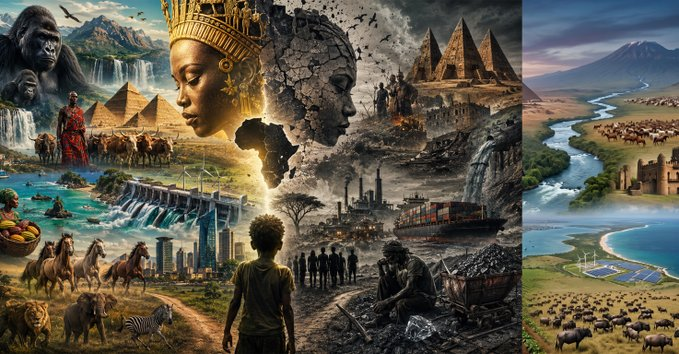
Veteran Ugandan journalist and commentator Charles Onyango-Obbo has published a lengthy commentary arguing that some African countries have successfully turned “storytelling and branding” into geopolitical and economic influence.
In a post titled “Size Matters (But Storytelling Wins); Or 15 Times Your Favourite African Country Turned Its Neighbour’s Glory Into Its Gold,” Onyango-Obbo argued that perception and global marketing often shape Africa’s international image more powerfully than geography or statistics.
“There are countries that, through clever marketing over the years, or a heritage of stronger storytelling – and even myth-making – have bent reality to their will,” Onyango-Obbo wrote on X.
He singled out Rwanda and Egypt as examples of nations that have successfully transformed cultural identity, tourism and historical narratives into globally recognisable brands.
“In the modern world, being the best is only half the battle; ensuring the world knows you are the best is where the money is,” he wrote.
The commentary listed several examples where popular perceptions about Africa differ from statistical or geographical realities.
Among the most discussed claims was Onyango-Obbo’s assertion that Uganda hosts the world’s largest single population of mountain gorillas, despite Rwanda often dominating global tourism marketing around gorilla trekking. According to the International Gorilla Conservation Programme, Uganda’s Bwindi Impenetrable National Park hosts nearly half of the world’s remaining mountain gorillas.
He also argued that Sudan, not Egypt, has the highest number of pyramids in the world. Archaeological studies estimate that Sudan has more than 200 pyramids linked to the ancient Kingdom of Kush, compared to roughly 138 in Egypt.
Onyango-Obbo further challenged perceptions about African livestock economies, noting that Ethiopia has Africa’s largest cattle population. Data from the UN Food and Agriculture Organisation show Ethiopia possesses one of the continent’s biggest livestock sectors, with tens of millions of cattle, sheep and goats.
The post also revisited long-standing debates over the source of the Nile. While the Source of the Nile in Jinja remains globally recognised as the point where the Nile exits Lake Victoria, hydrologists often identify the river’s most distant headwaters in Burundi through the Kagera basin system.
Other comparisons in the viral thread included:
• Ivory Coast being Africa’s dominant cocoa producer ahead of Ghana.
• Tanzania hosting Africa’s largest wildlife concentrations through the Serengeti ecosystem.
• Nigeria surpassing Kenya in the number of technology innovation hubs.
• Madagascar having Africa’s longest coastline.
• Fasil Ghebbi in Ethiopia being one of Africa’s largest indigenous castle complexes.
The thread generated intense reactions online, with many users praising the journalist for highlighting lesser-known African realities, while others challenged some of the comparisons and statistical interpretations.
Tourism experts and communication analysts said the post underscored the growing importance of branding and narrative control in shaping investment, tourism and international perception.
“Countries that tell compelling stories about themselves tend to attract more tourism, attention and even diplomatic influence,” media analyst Moses Serugo told local radio discussions following the viral post.
The discussion also revived conversations about how African nations market their heritage, natural resources and cultural identities in a highly competitive global tourism and investment landscape.