

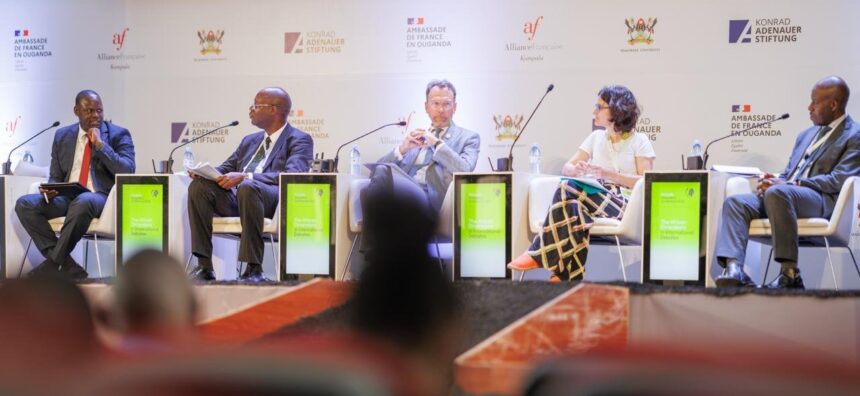
KAMPALA – Leading scholars, diplomats, and policymakers have called for Africa to take control of its global narrative as the 9th Kampala Geopolitics Conference opened at Makerere University under the theme “African Dimensions in International Debates.”
The two-day conference, held from April 15–16, 2026, at the university’s Main Hall, has brought together global and African thought leaders to examine shifting geopolitical dynamics and Africa’s place in them.
In remarks delivered on her behalf by the University Secretary, Yusuf Kiranda, Acting Vice Chancellor Prof. Sarah Ssali, emphasised the urgency of shaping Africa’s narrative.
Quoting Nigerian author Chinua Achebe, she said: “Until the lions have their own historians, the history of the hunt will always glorify the hunter.” “This conference is our commitment to telling Africa’s story on Africa’s terms,” she added.
Prof Ssali noted that global events—from shifting trade systems to conflicts in the Middle East—have direct consequences for Africa. “We can no longer afford to treat global affairs as distant abstractions. What happens in Washington, Brussels, Beijing, Paris, London, or Riyadh does not stay there. It arrives at our doorstep,” she said.
She also called for institutional strengthening of the conference. “The time has come to establish a dedicated secretariat for the Kampala Geopolitics Conference,” Kiranda said.
France backs African-led global debate
Virginie Leroy, Ambassador of France to Uganda, described the conference as a vital platform for global dialogue anchored in African perspectives. “For the past 8 years, the Kampala Geopolitics Conference has been providing an interactive platform for dialogue and free exchange on contemporary, regional and international debates,” she said.
She added that the platform has successfully bridged global and African discourse. “Inspired by the Nantes Geopolitics Conference… it has successfully brought global debates onto the African stage and African perspectives into global conversations,” Leroy noted.
Highlighting Uganda’s strategic position, she said: “Uganda stands at the heart of East Africa… rich in resources, talent, and opportunity.”
But she cautioned that the region faces complex challenges, including conflict, displacement, and shifting global financing. “This moment calls not only for observation, but for deeper analysis, open debate, and… collective action toward concrete and forward-looking solutions,” she said.
We are living through times of transition
Anna Reismann, Country Director of the Konrad-Adenauer-Stiftung in Uganda and South Sudan, said the conference comes at a time of global uncertainty. “We are certainly living through times of transition. Challenges to our institutions and to long-standing alliances are evident,” she said.
Reismann noted that traditional systems are being questioned both externally and internally. “Long-standing institutions… are undergoing profound change,” she added.
At the same time, she pointed to opportunities for renewal. “All the proposed topics reflect a deliberate effort… not only to acknowledge the multiple changes and challenges, but also to explore… new approaches… and shaping new realities,” she said.
She emphasised Africa’s growing geopolitical relevance. “The African region has become an increasingly prominent arena of international engagement amid shifts in the global distribution of power,” Reismann said.
Cultural diplomacy and language in geopolitics
Loïc Boivin, Director of Alliance Française Kampala, highlighted the role of language and culture in shaping global discourse.
“As one of 800 global centres, Alliance Française contributes to the promotion of French language and culture,” he said. “French connects over 400 million people and continues to thrive as a widely used language across Africa,” Boivin added.
Rethinking development financing
Leonard Zulu, United Nations Resident Coordinator in Uganda, pointed to declining aid flows. “A lot of overseas development assistance is being cut but there are resources domestically and partnerships that we can take advantage of,” he said.
He added: “The SDGs provide the UN with a road map… and we facilitate the convening of key partners.”
Marc Trouyet of the French Development Agency stressed the need for mutual partnerships. “Shifting from development assistance to mutually beneficial partnerships is key for Africa’s future development agenda,” he said.
He also raised concerns about investment readiness. “Private investors… are looking to invest in good projects, but are these fundable projects available?” Trouyet asked.
Nathalie Ferrière cautioned that aid trends are uneven. “Despite ODA reaching a record high… support to Africa declined when these factors are excluded,” she said.
She added: “We still haven’t proven if partnerships are better than the traditional form of development assistance.”
Dr Asumani Guloba highlighted the role of domestic resources.“Africa needs what we call patient capital. We need to tap into pension funds,” he said.
He emphasised the importance of the private sector. “The Indigenous private sector delivers over 80% of revenue and employment… we need to improve the environment for doing business,” Guloba added.