

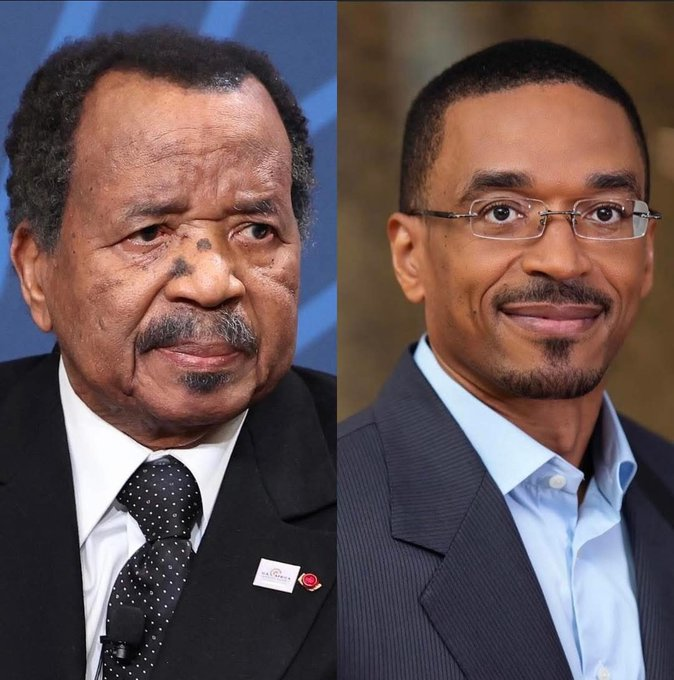
Cameroon’s President Paul Biya, 93, the world’s oldest serving head of state) issued an official presidential decree appointing his son, Franck Emmanuel Biya, as Vice President of the Republic, Head of the Armed Forces, and Minister Delegate at the Ministry of Defence.
If Paul Biya is not available, his duties will be taken over by his son.
A growing debate has emerged across Africa over what analysts describe as a shift toward “dynastic politics,” with several long-serving leaders accused of positioning family members for succession in moves critics say risk weakening democratic institutions.
The discussion has been amplified by commentary from political analysts, including Charles Onyango-Obbo, who points to a pattern in which veteran leaders consolidate power by elevating close relatives into key state positions.
In Cameroon, President Paul Biya—one of the world’s longest-serving leaders—has been at the centre of recent scrutiny. Reports circulating online claim moves to reintroduce a vice presidency and position his son, Franck Biya, in a role that could place him in line for succession. However, no official confirmation has been issued by the Cameroonian government regarding such constitutional changes.
A similar dynamic is often cited in Equatorial Guinea, where President Teodoro Obiang Nguema Mbasogo appointed his son, Teodoro Nguema Obiang Mangue, as Vice President in 2016, placing him firmly within the country’s line of power.
In Uganda, President Yoweri Museveni has overseen the rise of his son, Muhoozi Kainerugaba, who currently serves as Chief of Defence Forces. While he holds no elected political office, analysts widely view him as an influential figure in Uganda’s power structure.
Elsewhere, in the Republic of the Congo, President Denis Sassou Nguesso has appointed his son, Denis-Christel Sassou Nguesso, to senior government roles, while in Eritrea, President Isaias Afwerki has increasingly relied on his son, Abraham Afwerki, in diplomatic and advisory capacities.
Even in countries not traditionally associated with dynastic rule, questions have been raised. In Tanzania, President Samia Suluhu Hassan has faced criticism from some quarters over the appointment of close relatives to government positions—claims that remain contested and politically sensitive.
Political observers say the trend, whether perceived or real, reflects a broader concern among long-serving leaders about legacy, security, and continuity after leaving office.
“Many of these leaders have been in power for decades. The question of succession becomes deeply personal and political at the same time,” said a Kampala-based governance analyst.
Critics argue that concentrating power within families undermines meritocracy and weakens state institutions, while supporters maintain that such appointments can ensure stability and continuity in countries with fragile political systems.
As debates intensify, the issue of leadership transition—and whether it remains institutional or becomes familial—is likely to remain a defining question for governance across parts of the continent.