
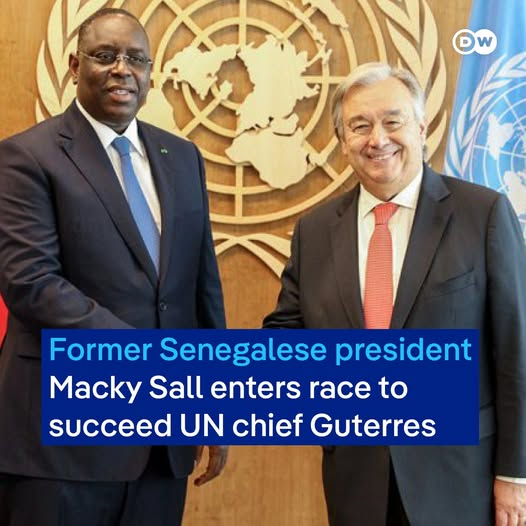
Former Senegalese president Macky Sall has officially joined the race to become the next United Nations Secretary-General Antonio Guterres successor, entering the global diplomatic contest ahead of the 2027 leadership transition.
Sall was nominated by Government of Burundi and presented by Évariste Ndayishimiye in his capacity as chair of the African Union.
The UN Secretary-General’s current term ends in December 2026, with the new five-year mandate expected to begin on January 1, 2027. The selection process is anticipated to commence by the end of July 2026.
If elected, Sall would become the third African to hold the United Nations’ top diplomatic position, following Boutros Boutros-Ghali of Egypt and Kofi Annan of Ghana.
Growing Field of Candidates
Sall joins other declared candidates, including former Chilean president Michelle Bachelet and Argentine nuclear scientist Rafael Grossi.
The government of Costa Rica Government has also proposed Rebeca Grynspan as a potential candidate.
Diplomatic analysts say the race could reflect broader geopolitical competition among regions seeking leadership representation at the United Nations.
Domestic Political Background
Sall served as Senegal’s president from 2012 to 2024. His tenure was marked by infrastructure development initiatives but also faced criticism from opposition groups over alleged fiscal management issues.
Reports suggest that political tensions at home could influence perceptions of his candidacy, although supporters argue his experience in governance and international diplomacy strengthens his qualifications.
UN Selection Process
The United Nations Secretary-General is appointed by the UN General Assembly upon recommendation of the Security Council, where any of the five permanent members can veto a candidate.
Historically, regional rotation and diplomatic consensus have influenced selections, though the process is not formally governed by regional quotas.
African Leadership Context
Should Sall win the position, he would join a small group of Africans who have led the world body, reinforcing Africa’s longstanding aspiration for representation in global multilateral leadership.
The UN leadership contest is expected to attract more candidates as member states continue informal consultations ahead of the formal selection phase.