
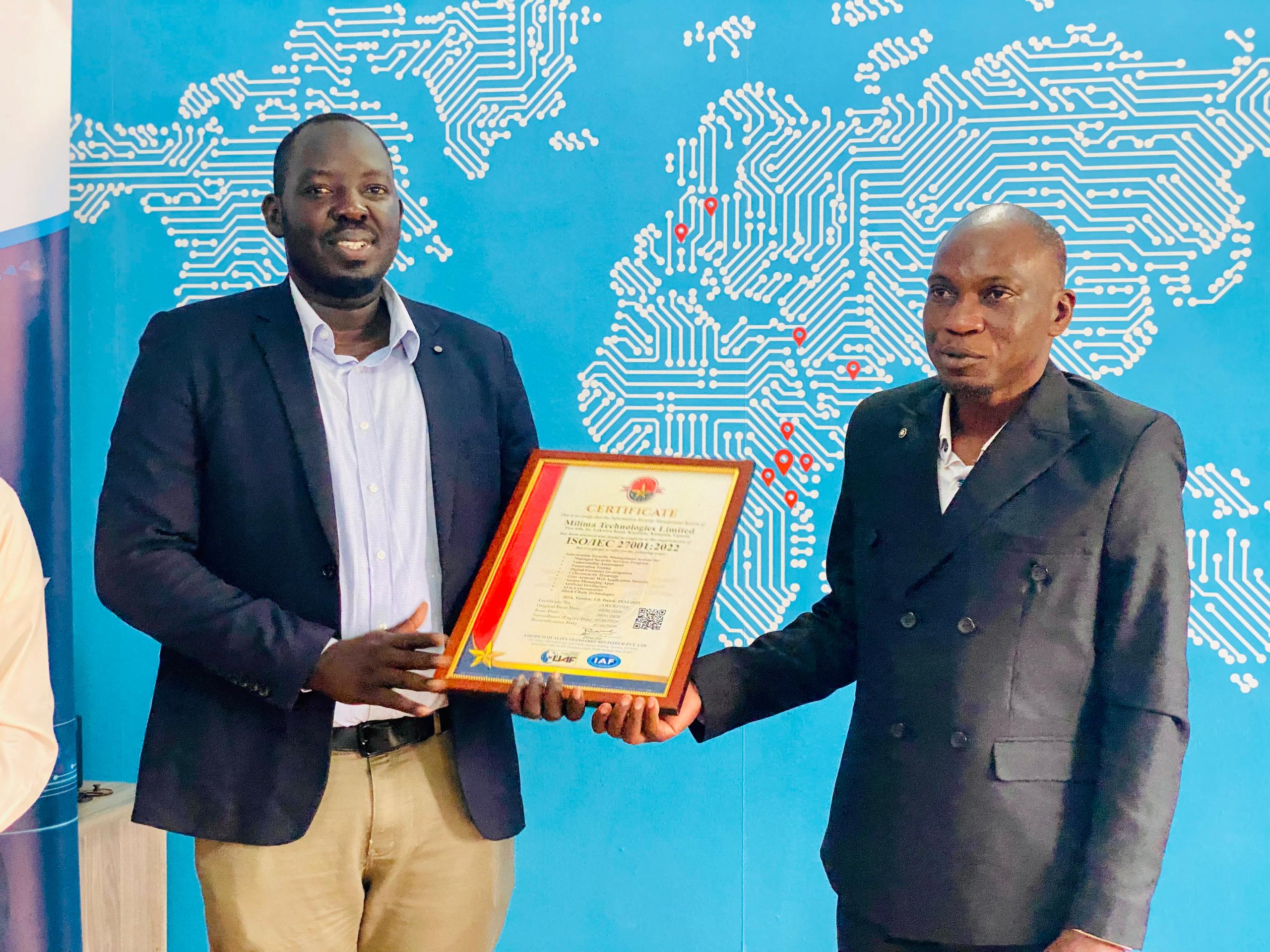
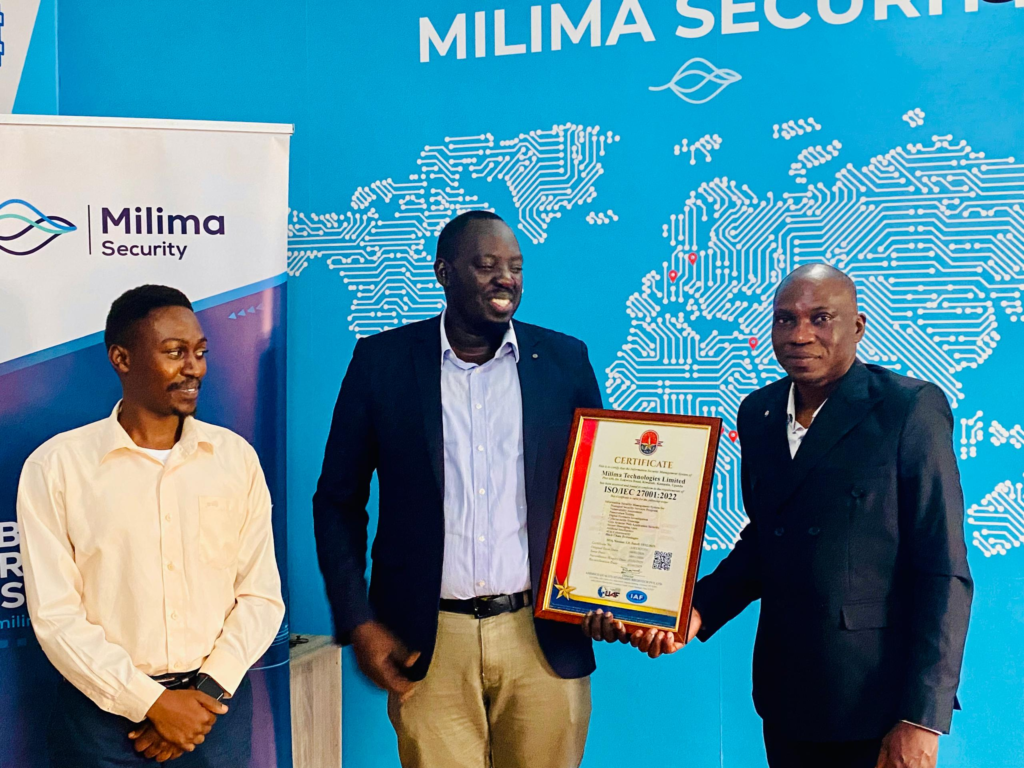
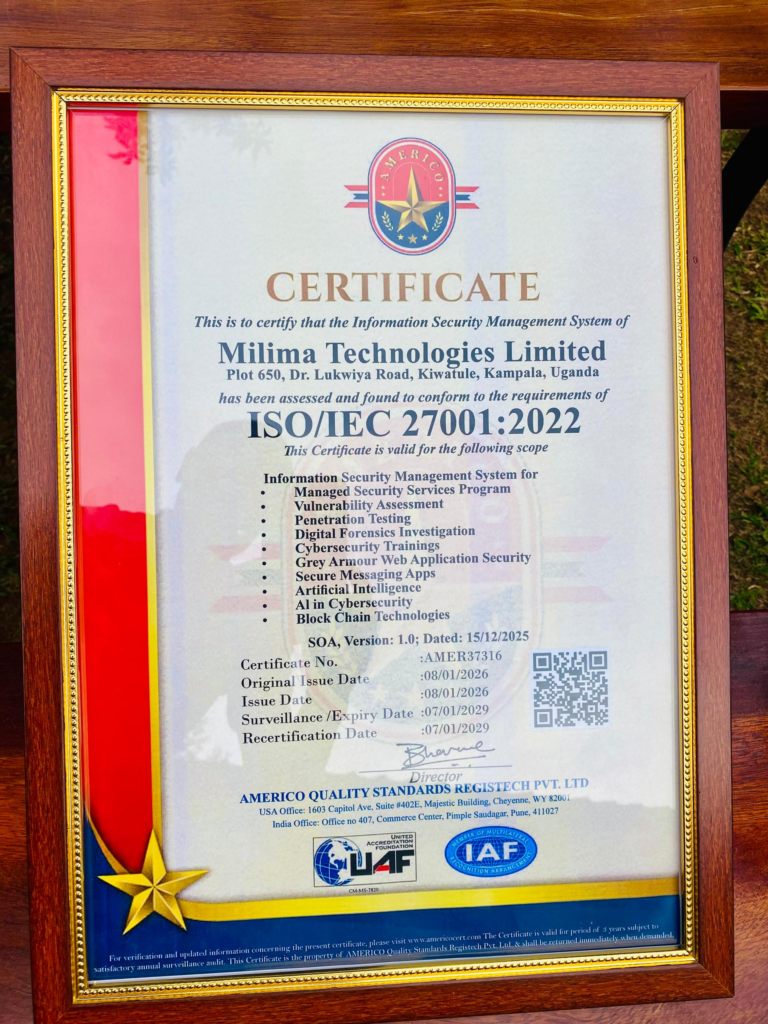
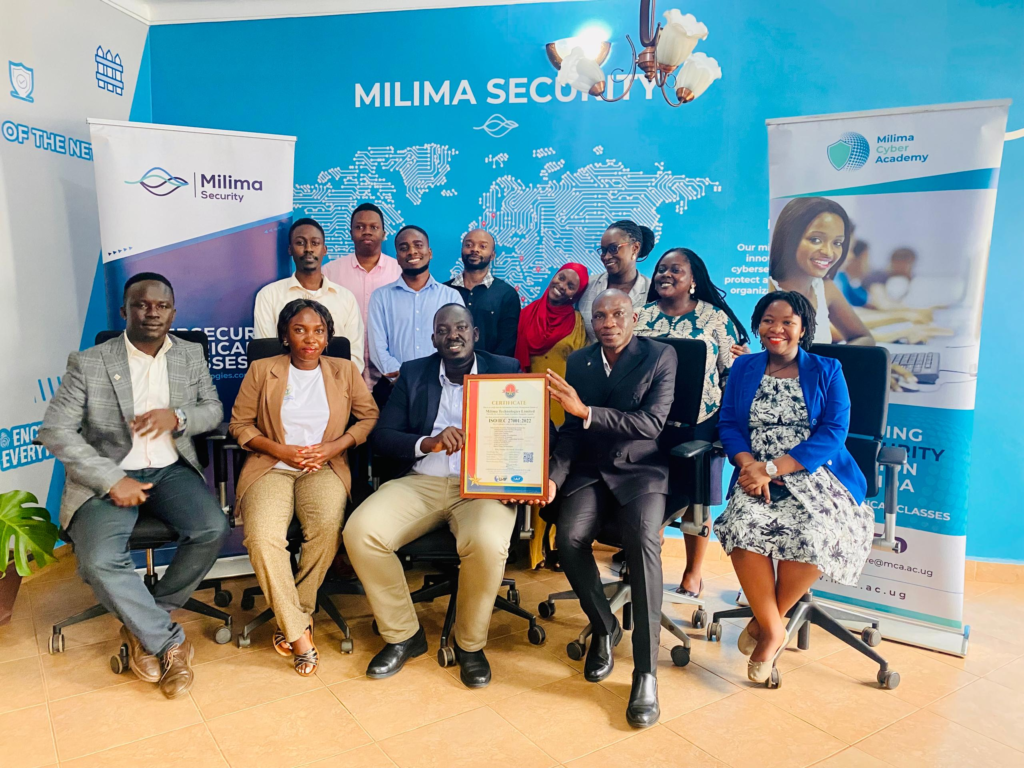
Milima Security, a leading Ugandan cybersecurity firm, has been awarded the ISO/IEC 27001 certification, the internationally recognised standard for Information Security Management Systems (ISMS), marking a major milestone in the company’s growth and regional expansion strategy.
Founded in 2016, Milima Security has grown from an indigenous Ugandan startup into a trusted regional provider of cybersecurity services, supporting public and private sector organisations, ministries, departments and agencies (MDAs), and small and medium enterprises (SMEs) to safeguard critical digital infrastructure in an increasingly complex threat environment.
The certification provides independent assurance that Milima Security manages information securely, consistently, and in line with international best practices—a requirement that is becoming increasingly critical for regional clients, partners, and regulators.
Speaking on the achievement, Emmanuel Chagara, CEO and Founder of Milima Security, said the certification reflects a decade-long journey of growth, discipline, and strategic investment.
He noted that Milima’s service portfolio has expanded significantly over the years. “Our work in cybersecurity includes monitoring and surveillance infrastructure through our Managed Security Services Program (MSSP), penetration testing and vulnerability assessments, digital forensics investigations, and extensive cybersecurity research,” he explained.
As the company expanded, Chagara said aligning with globally recognised standards became unavoidable. “ISO certifications are recognised worldwide—whether in Japan, Uganda, or the United States. They are widely regarded as a benchmark for an organisation’s maturity, credibility, and capability to deliver specific services,” he said.
Why ISO/IEC 27001 Matters
ISO/IEC 27001 specifically focuses on information security governance, data protection, client data handling, and record management. Chagara emphasised that the certification process was both demanding and transformative.
“You cannot credibly claim to provide cybersecurity services if you do not have strong internal cybersecurity policies, or if your own staff do not adhere to basic cybersecurity principles,” he said.
According to Chagara, the certification is already opening doors to higher-level engagements. “This certification is a game-changer. Many large organisations—both local and international—require ISO 27001 as a prerequisite for engagement. Institutions such as the Bank of Uganda, MTN, and several government ministries often demand it,” he said.
Certification Body’s View
Moses Clive Ogwe, Country Representative and Auditor at Finecert, the ISO certification and training body headquartered in India, said ISO standards are designed to ensure organisations remain aligned with global best practices.
“ISO (International Organisation for Standardisation) develops international standards that guide how organisations operate and ensure they remain competitive as technologies and market demands evolve,” Ogwe said.
He explained that ISO certification is not limited to one sector. “ISO certification cuts across industries. Whether a company is in cybersecurity, manufacturing, or services, the standards are tailored to its specific operations,” Ogwe noted.
On Milima Security’s certification, Ogwe added: “Obtaining ISO/IEC 27001 means Milima’s clients can be confident that their data is handled according to international best practices. It also establishes Milima as an internationally recognised and credible brand.”
Inside the Certification Process
The ISO/IEC 27001 implementation at Milima Security was led internally by Emmanuel Chepkwurui, a Security Analyst who served as Project Lead and Senior Information Security Officer (SISO) during the certification process.
“The SISO is the chief custodian of the ISO 27001 framework within an organisation, responsible for ensuring information security processes and standards are properly implemented across all operations,” Chepkwurui explained.
He said the final certification phase, including audits and assessments, took about three months, following earlier work on policy design and system development. “We conducted internal audits to ensure our systems aligned with ISO requirements and carried out intensive staff training to prevent accidental mishandling of information,” he said.
Milima Security views ISO/IEC 27001 as a foundation for secure and responsible growth, rather than a one-off compliance exercise. The company says information protection is now deeply embedded in its daily operations, strategic decision-making, and continuous improvement processes.