
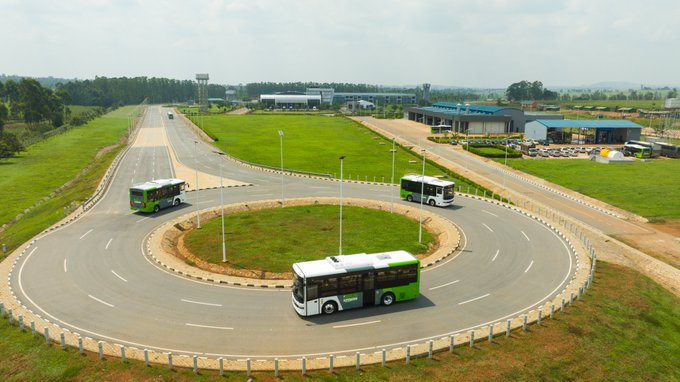
E-Bus Xpress has ended its free-ride trial on three Kira Municipality routes, with passengers beginning to pay fares from Monday, September 7, 2026, as Uganda’s locally manufactured electric buses move into regular commercial service.
The transition follows a nine-day promotional period during which commuters were allowed to use the buses free of charge after the Kira routes were launched on August 28.
The service is operated by E-Bus Xpress Kiira Ltd, a subsidiary of Kiira Motors Corporation, with the buses manufactured locally by Kiira Motors.
The government says the expansion is part of efforts to introduce cleaner, safer and more organised mass transportation in the Greater Kampala Metropolitan Area.
The three routes connect rapidly growing residential areas around Kira to the Ntinda transport hub.
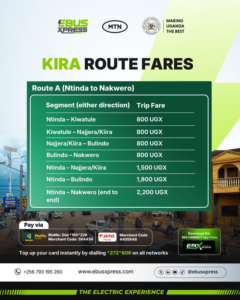
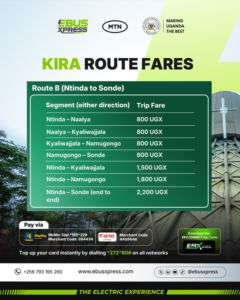
They are: Ntinda–Najjera–Kira–Kitukutwe–Kiwologoma–Nakwero, Ntinda–Naalya–Kyaliwajjala–Namugongo–Sonde and Ntinda–Kisasi–Kyanja–Kungu.
The Uganda Media Centre said 15 electric buses were commissioned for the Kira routes, with five buses assigned to each corridor.
E-Bus Xpress announced that fares would take effect from September 7, following the free-ride period that ended on September 6.
Adult fares start at Shs800, depending on the distance travelled, while students pay reduced fares starting at Shs400.
On the Ntinda–Sonde route, commuters travel through Naalya, Kyaliwajjala and Namugongo before reaching Sonde. The Ntinda–Kungu service runs through Kisasi and Kyanja.
The third route serves Najjera, Kira, Kitukutwe and Kiwologoma before terminating at Nakwero.
Cashless travel
Unlike conventional taxis and buses where passengers normally pay conductors with cash, E-Bus Xpress has adopted a cashless payment system.
The system is being supported by MTN Uganda, which allows passengers to pay using MTN Mobile Money.
Passengers can also use E-Bus Xpress cards, while the company has introduced digital options aimed at reducing the need to carry cash. MTN says it is also providing Wi-Fi connectivity on the buses.
The buses are fitted with air conditioning, Wi-Fi, phone-charging facilities and safety systems, offering a markedly different experience from the crowded minibuses that dominate much of Kampala’s public transport system.
E-Bus Xpress describes its service as an electric mass-transit system designed to provide scheduled, safer and more predictable travel.
More than just electric buses
The Kira rollout is part of a wider government push to change how people move around the capital.
Kiira Motors says E-Bus Xpress began operations in Kampala in May 2026 with an initial fleet of eight Kayoola electric buses.
The company has since expanded its network, with plans to add more routes and buses across the metropolitan area.
The Independent reported that E-Bus Xpress plans to expand its fleet to 50 buses by the end of 2026, while government plans have pointed to a much larger electric-bus network across Greater Kampala.
The ambition is significant because Kampala’s transport problem is not simply a shortage of vehicles. It is a problem of organisation.
Thousands of taxis compete for road space; private cars multiply; passengers wait without reliable timetables; and congestion turns relatively short journeys into daily ordeals.
Electric buses cannot solve all of that by themselves.
But a scheduled bus carrying many passengers, operating on a defined route and using locally manufactured technology presents a different model from the informal system Uganda has relied upon for decades.
The bigger question now is whether commuters will continue choosing the electric buses once the novelty of free rides disappears.
For E-Bus Xpress, Monday marks that test.
The buses are no longer merely something to try.
They are now something Ugandans must decide whether to pay for.