

Uganda’s export drive is entering a more organised phase as the Uganda Free Zones and Export Promotions Authority (UFZEPA) adopts a special economic zones approach to support exports.
Formed in 2024 by merging the Free Zones regulator and the export promotions agency, the Authority now oversees both special economic zones and national export marketing under one roof.
The authority seeks to make it easier to produce, add value and sell Ugandan goods and services abroad, while giving investors and exporters a more predictable environment.
“As a country, we already have markets that are established, but we also have markets we need to get into, so developing these nodes of production and distribution is key,” says Hez Kimoomi Alinda, the Executive Director of Uganda Free Zones and Exports Promotions Authority.

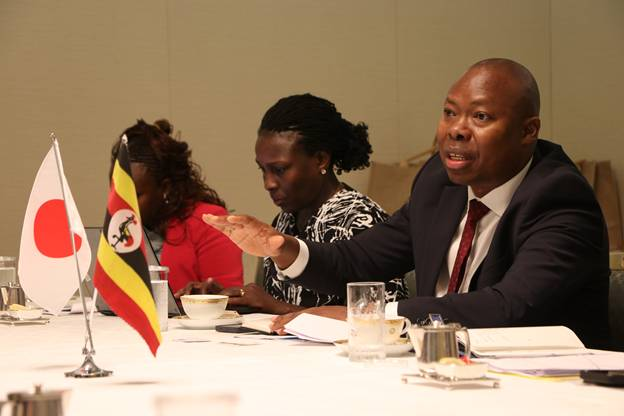
Hez Kimoomi Alinda, Executive Director, UFZEPA recently at a diplomatic meeting in Japan
Recent numbers explain why this matters to ordinary Ugandans. National exports of goods and services have almost doubled in four years, rising from about USD 6.8 billion in FY 2020/21 to roughly USD 13.3 billion in FY 2024/25. Within designated Free Zones, private investment has climbed above USD 2.1 billion, with more than 40 licensed private zones creating industrial parks, logistics centres and agro‑processing facilities.
“The public Free Zone at Entebbe International Airport—now nearing completion—is expected to ease movement of high-value, time-sensitive exports such as fresh produce and light manufactures. We are prioritising coffee, cocoa and horticulture producing enterprises that export through Entebbe International airport,” Hez Aliinda Kimoomi adds.
As Uganda chases a USD 500 billion GDP status by 2040, the authority is tasked with an uphill task to coordinate all public and private trade efforts that will catalyse local production whilst establishing new markets that will consume Ugandan produce.
In FY 2024/25 alone, UFZEPA has presented Ugandan produce to a range of new markets by strengthening linkages with Japan through a Memorandum of Understanding with the Osaka Chamber of Commerce following Uganda’s coordination of participation in Expo 2025 Osaka, connecting East Africa Coffee in Qatar to NUCAFE for Robusta and Arabica coffee, and conducting pre‑capacity assessments in the milk value chain to respond to growing demand from Algerian buyers.

Esther Nekambi, executive director of Uganda Flowers Exporters Association, making a presentation at the Uganda-Japan Trade and Investment Forum 2025
Esther Nekambi, executive director of Uganda Flowers Exporters Association, while on a trip to Japan with UFZEPA delegation in June 2025 is quoted saying: “The market in Japan is big, especially in Osaka, its bigger than Belgium which we supply, The policies for exporting our cuttings are more favorable in Japan so this is surely a new market to explore better.“
Beyond infrastructure, the Authority is paying closer attention to sustainability and market standards. Recent joint trainings with the environment regulator, NEMA, are designed to ensure that factories in Free Zones comply with environmental rules from the outset, reducing future disputes and making Ugandan exports more acceptable in strict markets.
Partnerships with chambers of commerce abroad, including in Japan, are meant to open doors for local firms, especially small and medium-sized enterprises, to meet quality requirements and plug into regional and global value chains.